Cisco Firepower Explained: NGFW, FTD, and How Teams Use It
• Nathaniel Miller
Cisco Firepower is Cisco’s next-generation firewall (NGFW) platform. The naming is the confusing part: Firepower, FTD, FMC, FDM, ASA with FirePOWER Services, and Secure Firewall overlap in ways that make inherited deployments hard to read. If you have walked into a Cisco security estate and could not tell what you were looking at, that confusion is the product history, not you.
Cisco acquired the technology, ran it alongside an existing firewall line, merged them, and renamed things more than once. Untangling that is most of what people actually need before they can tune policy, plan a migration, or decide whether the platform belongs in the architecture.
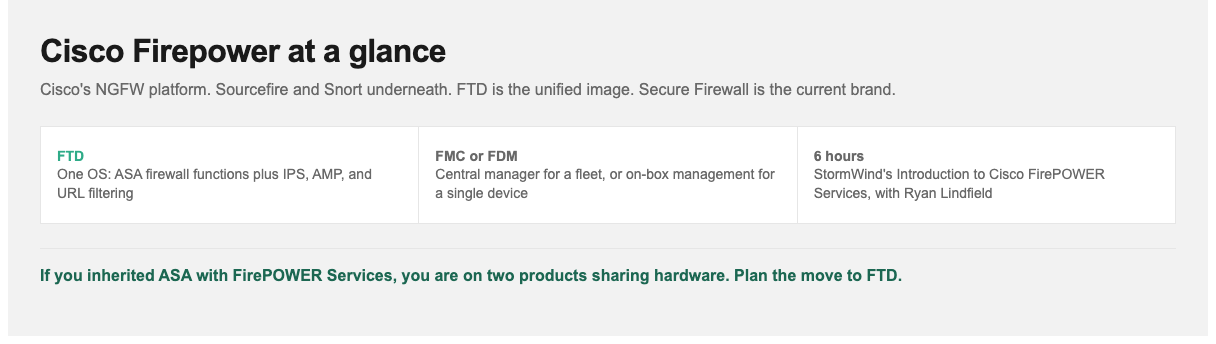
FTD is one image. ASA with FirePOWER Services is two products on one box. Secure Firewall is the current brand for the same technology.
What Cisco Firepower Is
Where a traditional firewall makes decisions based on ports, protocols, and IP addresses, a next-generation firewall inspects traffic at the application layer and adds intrusion prevention, malware detection, and URL filtering into a single enforcement point.
The technology originated with Sourcefire, which Cisco acquired in 2013. Sourcefire created Snort, the open-source intrusion detection engine, and that lineage matters. Snort remains the detection engine underneath Firepower, which is why Firepower’s IPS capability is generally well regarded even by people who dislike other aspects of the platform.
The Naming, Decoded
| Term | What it actually is |
|---|---|
| Firepower | The umbrella name: the platform and product family, and also the hardware appliance series (Firepower 1000, 2100, 4100, 9300) |
| FTD (Firepower Threat Defense) | The unified software image. Combines ASA firewall functions with Firepower NGFW features in one operating system. This is the current, strategic direction. |
| FMC (Firepower Management Center) | The centralized management platform: a separate appliance or virtual machine that manages multiple FTD devices. Formerly called Defense Center. |
| FDM (Firepower Device Manager) | On-box management for a single FTD device. No separate appliance needed, fewer features. |
| ASA with FirePOWER Services | The legacy arrangement. Classic ASA firewall software with a Firepower module bolted on: two separate systems, two management interfaces, on one box. |
| Secure Firewall | Cisco’s current marketing name for the portfolio. Same technology; branding refresh. |
The single most useful distinction: ASA with FirePOWER Services is two products sharing hardware, while FTD is one unified product. If you are running the former, you are on the legacy path and migration to FTD is the expected direction. If you see “Secure Firewall” in current Cisco documentation, read it as Firepower.
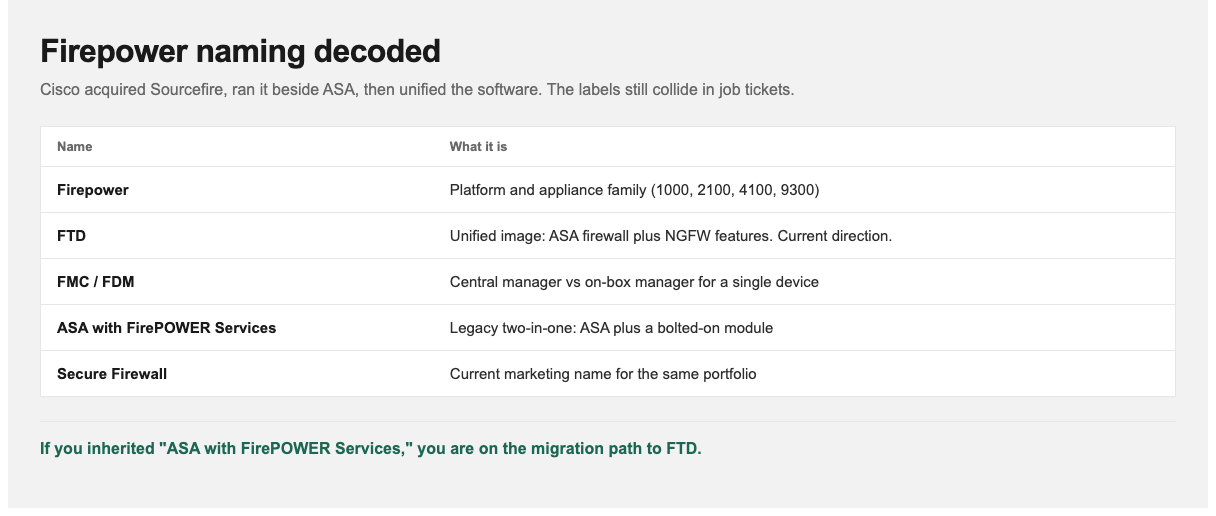
ASA with FirePOWER Services is two products sharing hardware. FTD is one unified image. Secure Firewall is the current brand for the same technology.
Firepower vs Traditional ASA
The classic Cisco ASA was a stateful firewall. Excellent at what it did, and what it did was inspect connections at the network and transport layers, plus VPN termination.
| Classic ASA | Firepower / FTD | |
|---|---|---|
| Inspection basis | Ports, protocols, IP addresses | Applications, users, content |
| Intrusion prevention | No | Yes, Snort-based |
| Malware inspection | No | Yes, via AMP |
| URL filtering | No | Yes, category-based |
| Application awareness | Limited | Yes: identifies applications regardless of port |
| Configuration style | CLI-centric, familiar to Cisco engineers | GUI-centric via FMC |
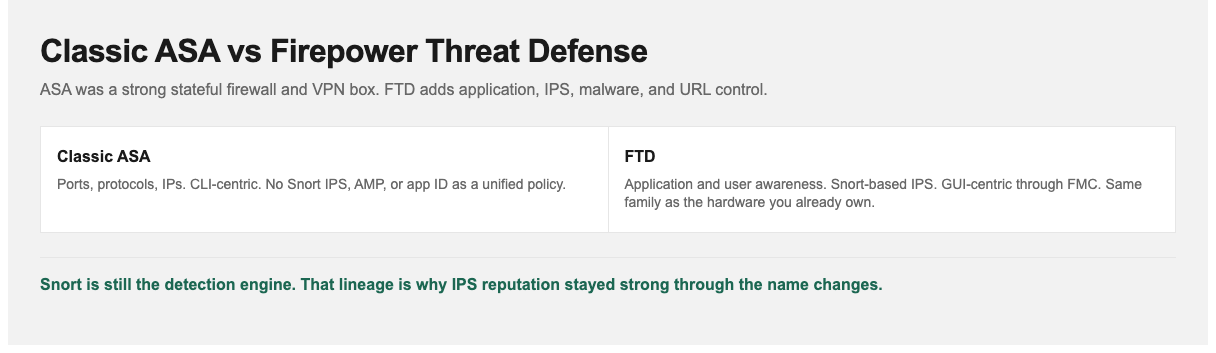
A traditional allow on TCP 443 permits everything on 443. An NGFW can tell business traffic from a tunneling app on the same port.
The practical significance of application awareness: a traditional firewall permitting TCP 443 permits everything using TCP 443, which today is most of the internet. An NGFW can distinguish between legitimate business traffic and a tunneling application both using port 443. That is why port-based rules alone stopped being sufficient.
Worth stating plainly: many Cisco engineers found the FTD transition frustrating, because decades of ASA CLI fluency translated imperfectly to a GUI-driven management model. That is a real adjustment cost, not just a preference.
Core Capabilities
Next-generation firewall. Application-layer visibility and control, with policies written against applications and users rather than only ports and addresses.
Next-generation IPS. The Snort-based intrusion prevention engine, updated with rules from Cisco Talos, one of the larger commercial threat intelligence operations. This is generally considered Firepower’s strongest capability.
AMP (Advanced Malware Protection). File inspection and malware detection, including retrospective analysis. If a file initially assessed as clean is later determined malicious, Firepower can tell you where that file went in your network. That capability is genuinely valuable during incident response.
URL filtering. Category and reputation-based web filtering.
VPN. Both site-to-site and remote access.
Identity integration. Policies based on users and groups from Active Directory rather than just IP addresses.
How FMC Management Works
FMC is a separate management appliance or virtual machine that centrally manages your FTD devices. You configure policies in FMC and deploy them out to managed devices.
Key operational characteristics worth knowing before you commit to the architecture:
- It is a deploy model, not a live-edit model. Changes are staged in FMC and then explicitly deployed. Deployments take time, often minutes, and this surprises engineers used to immediate CLI changes.
- FMC is infrastructure you must run. It needs sizing, patching, and backing up. It is a genuine additional system, not a lightweight console.
- Policy hierarchy matters. Access control policies, intrusion policies, and file policies nest together, and understanding that structure is most of what makes FMC manageable.
- FDM is the alternative for a single device: simpler, no extra appliance, fewer capabilities. Fine for one firewall at a branch, insufficient for a fleet.
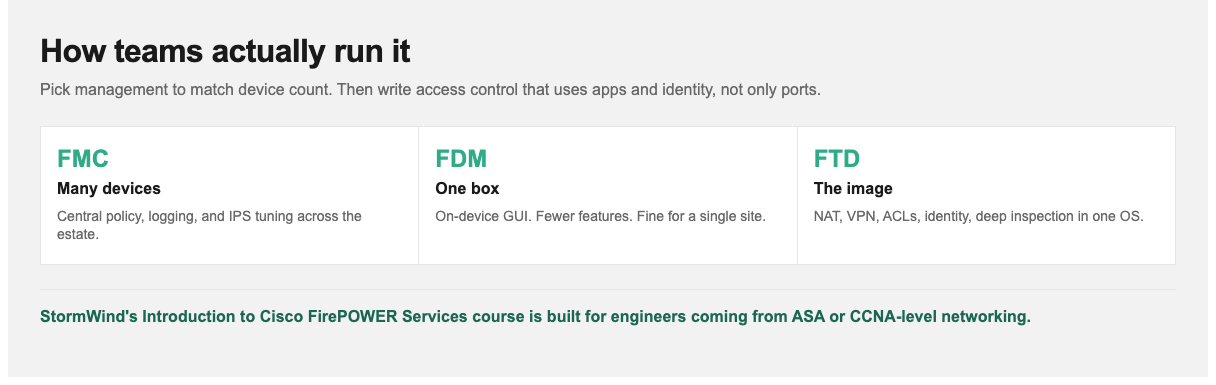
FMC becomes worthwhile with multiple devices or when you need correlated event visibility. For one firewall, FDM avoids real overhead.
The practical guidance: FMC becomes worthwhile with multiple devices, or when you need centralized policy and correlated event visibility. For a single firewall, FDM avoids real overhead.
Where It Fits in a Security Architecture
Firepower typically sits at network boundaries: internet edge, data center perimeter, between security zones, or terminating VPN connections. In Cisco-centric environments it also integrates with the broader portfolio: ISE for identity-based policy, Secure Endpoint for endpoint correlation, and SecureX or its successors for cross-product visibility.
That integration story is the strongest strategic argument for Firepower. If you are already running Cisco networking, ISE, and Cisco endpoint tooling, a Cisco firewall correlates with the rest of your estate in ways a third-party firewall generally will not.
Licensing, Briefly
Firepower licensing is subscription-based and feature-tiered. Base firewall functionality is included with the hardware. The capabilities that make it a next-generation firewall (IPS, malware inspection, URL filtering) are separate subscriptions, typically sold in one, three, or five-year terms.
Two practical implications. First, an unlicensed Firepower is largely just a firewall. The differentiating features are the licensed ones. Second, model total cost of ownership across the full term, not the hardware purchase. Confirm current licensing structure with Cisco or your partner, as the packaging has changed more than once.
Skills Needed to Run It
Firepower is not a platform you operate well by intuition. Teams running it effectively generally need:
- Solid networking fundamentals: routing, NAT, VLANs. Most Firepower problems that present as security issues are network problems. CCNA or equivalent is the recommended baseline.
- Understanding of the policy hierarchy: how access control, intrusion, and file policies interact.
- IPS tuning capability. Out-of-the-box intrusion policies generate false positives in any real environment. Tuning is ongoing work, and untuned IPS either gets ignored or gets disabled, both of which waste the license.
- Event analysis skills. FMC produces a great deal of data, and it is only valuable to someone who can interpret it.
- Migration experience if you are moving from ASA, since configurations do not translate cleanly.
Firepower vs Palo Alto vs Fortinet
These are the three NGFWs most teams compare. Detection capability is rarely the decider. Existing vendor investment, in-house expertise, licensing economics, and management preference usually are.
Cisco Firepower is strongest where you are already Cisco-centric. Excellent Snort-based IPS with Talos intelligence, and genuine integration with Cisco networking and identity products. Its weaknesses are management complexity and the FMC overhead, plus a learning curve for engineers coming from ASA CLI.
Palo Alto Networks is widely regarded as having the most coherent NGFW policy model and the best single-pane management experience. App-ID is mature and its architecture is clean. Generally the premium-priced option, and it is less integrated with Cisco environments.
Fortinet FortiGate is typically the strongest price-performance, with custom ASICs delivering high throughput per dollar and a broad integrated product ecosystem. Attractive for cost-sensitive deployments and distributed environments, though its unified management is less consistent across the wider product range.
All three are capable next-generation firewalls. An organization with Cisco networking and Cisco-skilled staff often gets more real security value from Firepower than from a technically marginally superior platform nobody on the team knows how to tune.
Learning Firepower Without a Default-Config Deployment
Firepower is a platform where training gaps show up directly as security gaps. The most common real-world outcome for an untrained team is a Firepower deployment running in near-default configuration: IPS in detection-only mode because nobody had time to tune the false positives, policies inherited from a migration nobody fully understood, and a license paying for capabilities that are not enforcing anything.
StormWind’s Introduction to Cisco FirePOWER Services is 6 hours with Ryan Lindfield: overview and use cases, management, ACLs, identity-based control, network discovery and NAT, and FTD troubleshooting including PKI and VPN. Recommended background is CCNA or equivalent. Live instruction is where you can bring your actual policy structure and event volume into the session and work through what to tune first. For teams migrating from ASA, an instructor who has done the migration is worth considerably more than documentation describing it.
If your estate is mixed-vendor, StormWind also trains Palo Alto PCNSE and Fortinet NSE7 Enterprise Firewall. Compare the products as architecture first. Then train the one you actually have to operate.
Start by identifying what you actually have. If it is ASA with FirePOWER Services, you are on the legacy path and should plan an FTD migration. If you are running FTD, check whether your intrusion policies are actually enforcing or sitting in detection-only mode, which is the most common way organizations pay for capability they are not using.
For more information, visit stormwindstudios.com or reach out to [email protected].
Frequently Asked Questions
What is the difference between Firepower and FTD?
Firepower is the umbrella platform and hardware family name. FTD (Firepower Threat Defense) is the unified software image combining ASA firewall functions with next-generation firewall features in a single operating system.
What is the difference between FTD and ASA with FirePOWER Services?
ASA with FirePOWER Services is the legacy arrangement: two separate systems with two management interfaces on one appliance. FTD is one unified product and is Cisco’s current direction.
What is FMC used for?
Firepower Management Center is a separate appliance or virtual machine that centrally manages multiple FTD devices, handling policy configuration, deployment, and event correlation. For a single device, FDM provides simpler on-box management.
Is Firepower the same as Cisco Secure Firewall?
Effectively yes. Secure Firewall is Cisco’s current branding for the portfolio. The underlying technology is Firepower.
Does Firepower use Snort?
Yes. The intrusion prevention engine is Snort-based, inherited from Cisco’s 2013 acquisition of Sourcefire, with rules supplied by Cisco Talos.
Is Firepower better than Palo Alto?
Neither is universally better. Firepower is stronger in Cisco-centric environments and has a well-regarded IPS. Palo Alto is generally considered to have a cleaner policy model and management experience. Existing vendor investment and in-house expertise usually matter more than feature comparison.
Do I need licenses for Firepower features?
Yes. Base firewall functionality comes with the hardware, but IPS, malware inspection, and URL filtering are separate subscriptions. Without them, you effectively have a conventional firewall.