IT Certification Roadmap 2026: Where to Start & Next Steps
• Nathaniel Miller
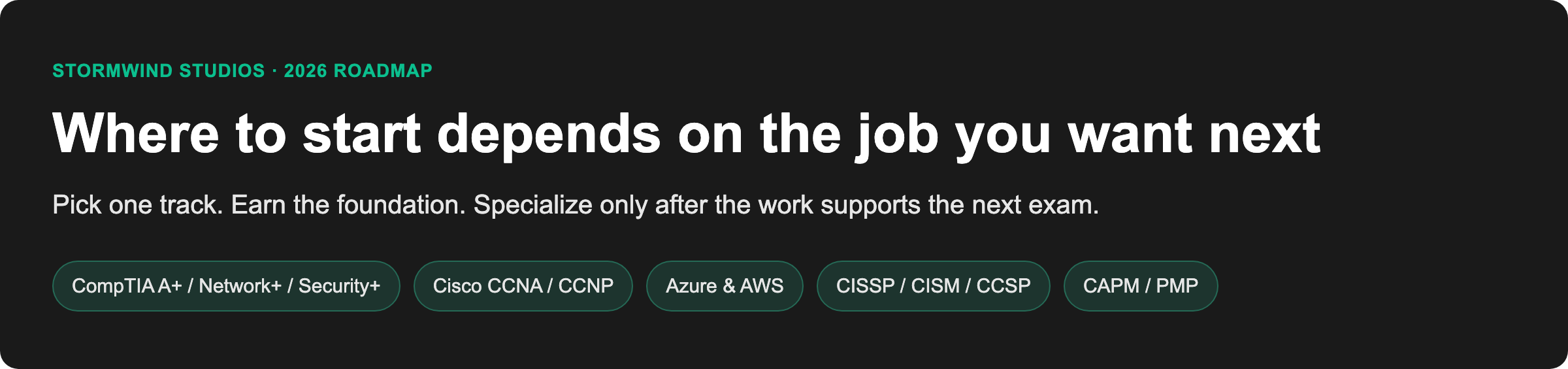
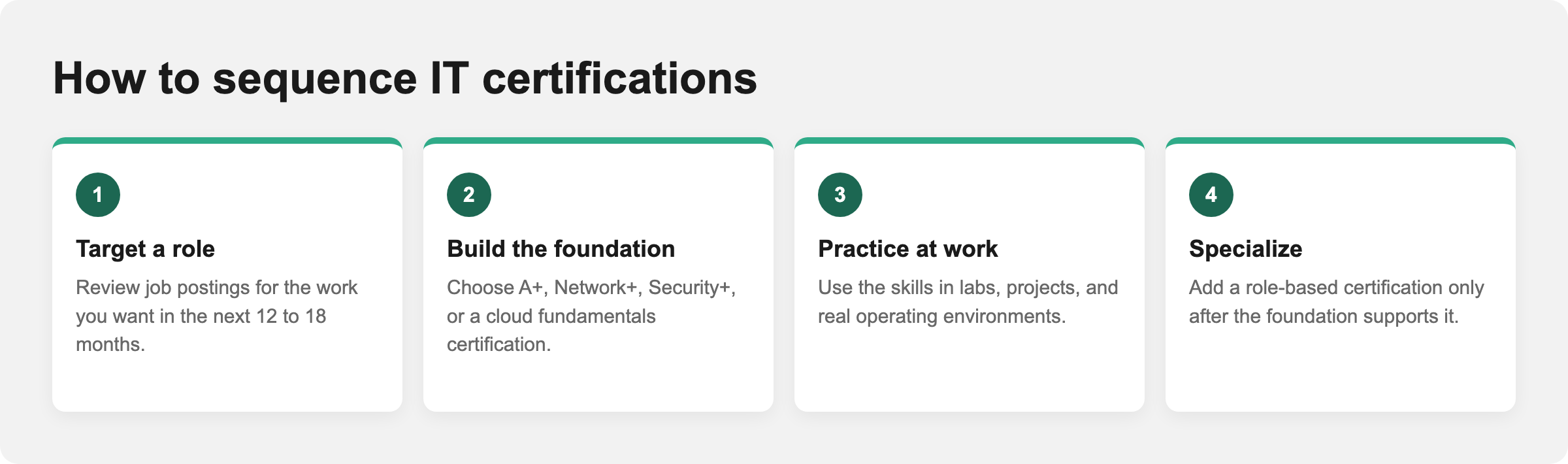
There are hundreds of IT certifications, but you do not need a hundred-item plan. You need one target role, one foundation credential, and one logical next step. This 2026 roadmap shows where CompTIA, Cisco, Microsoft Azure, AWS, cybersecurity, and project management certifications fit so you can build job-ready skills without collecting badges that do not support your work.
The value comes from sequencing. A specialist credential before the foundation can make the material harder than it needs to be. An expert certification before you have the required experience can leave you with a passed exam but no full credential. Use the paths below to choose deliberately.
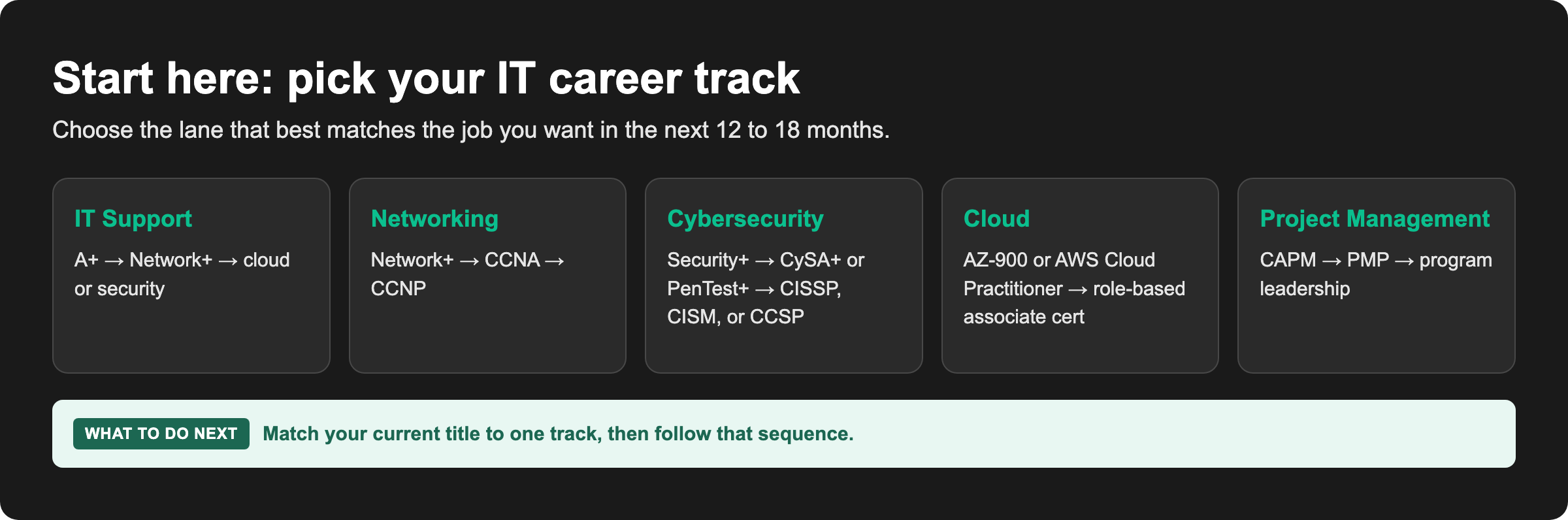
You do not have to stay in one lane forever. Support professionals move into networking. Network engineers move into security. System administrators move into cloud. The shared foundation is what makes those transitions possible.
The CompTIA Certification Roadmap: A+, Network+, and Security+
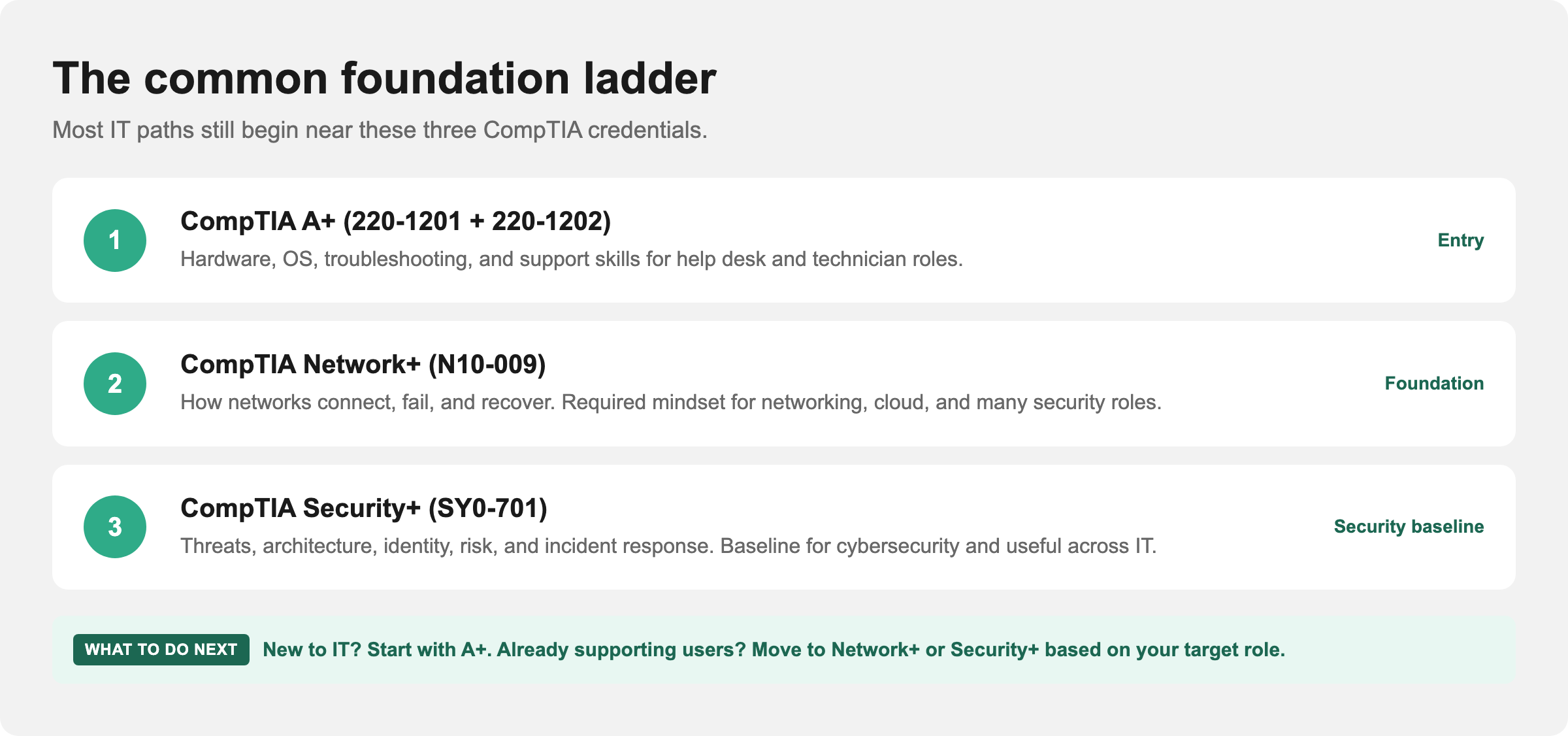
CompTIA certifications are the vendor-neutral foundation most IT careers still use. The standard sequence is A+ for support fundamentals, Network+ for connectivity, then Security+ for core security skills. From there you can stay on CompTIA with CySA+ or PenTest+, or branch into Cisco, cloud, or senior security credentials.
CompTIA A+ (220-1201 and 220-1202)
If you are new to IT, start with CompTIA A+ Core 1 and A+ Core 2. The current V15 certification validates hardware, operating systems, software, networking, security, cloud concepts, and troubleshooting across two exams. It is built for help desk, desktop support, and IT technician roles.
CompTIA Network+ (N10-009)
CompTIA Network+ explains how networks connect, operate, fail, and recover. It is the natural step after A+ for support professionals and the foundation for networking, infrastructure, cloud, and many security roles. If subnetting, VLANs, routing, wireless, and troubleshooting are part of your target job, Network+ belongs near the beginning of your plan.
CompTIA Security+ (SY0-701)
CompTIA Security+ establishes the core security vocabulary used across IT: threats, vulnerabilities, architecture, identity, risk, and incident response. It is the starting point for a dedicated cybersecurity path, but it also helps network, systems, and cloud professionals understand the security responsibilities built into their jobs.
After Security+, CompTIA’s specialist options are CySA+ for blue-team analysis or PenTest+ for offensive work. Those appear again in the cybersecurity track below when you are ready to specialize.
The 2026 IT Certification Roadmap by Track
| Track | Start | Build | Advance |
|---|---|---|---|
| IT Support | CompTIA A+ | Network+, Microsoft 365 | Specialize in networking, cloud, or security |
| Networking | Network+ | Cisco CCNA | CCNP Enterprise |
| Cybersecurity | Security+ | CySA+ or PenTest+ | CISSP, CISM, or CCSP |
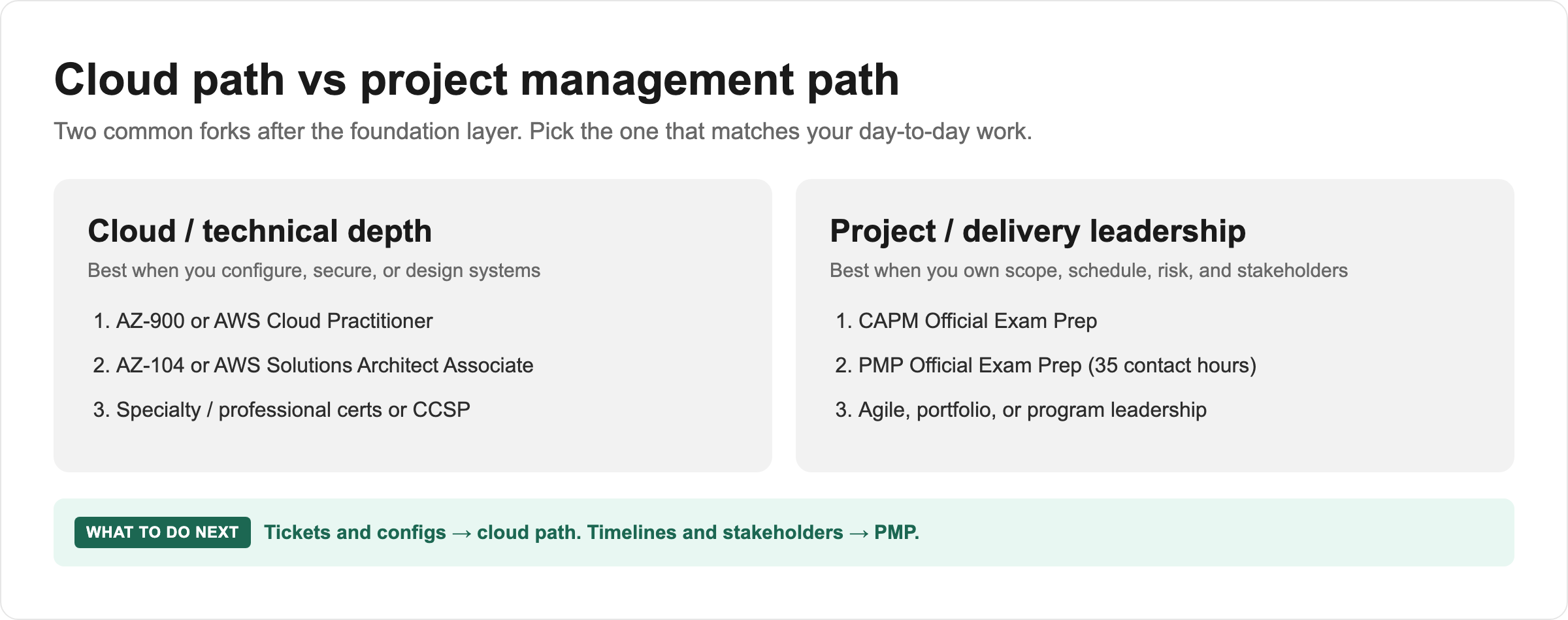
| Cloud | AZ-900 or AWS Cloud Practitioner | AZ-104 or AWS Solutions Architect Associate | Professional and specialty certs, or CCSP |
| Project Management | CAPM | PMP | Agile, portfolio, or program leadership |
The Cisco Certification Roadmap: CCNA to CCNP
The Cisco certification path is the most common vendor-specific networking ladder in enterprise IT. Most candidates start with vendor-neutral Network+, then move to CCNA for Cisco configuration skills, then into CCNP when their job already involves designing and troubleshooting production networks.
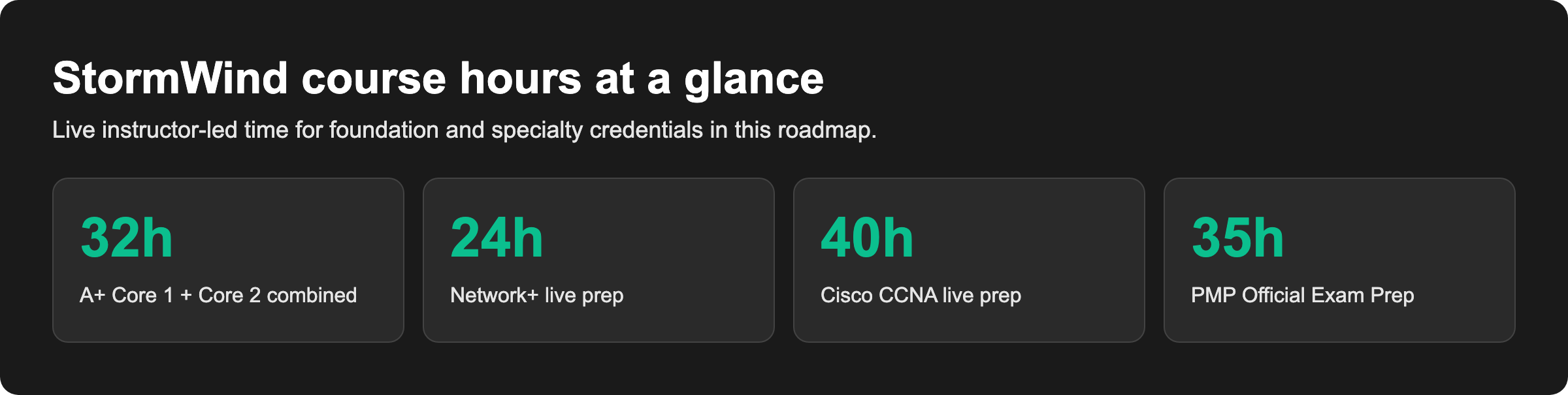
Network+ gives you vendor-neutral fundamentals. Cisco CCNA turns those concepts into Cisco configuration and troubleshooting skills across network fundamentals, IP connectivity, security, automation, and programmability. StormWind’s CCNA course provides 40 hours of live instruction for the 200-301 path.
After CCNA, choose the CCNP concentration that matches your work. Enterprise network professionals commonly begin with CCNP Enterprise ENCOR, then pair it with a concentration such as ENARSI for advanced routing and services. Do not rush into CCNP if you are not yet configuring and troubleshooting networks regularly. The professional-level material assumes operating experience.
The Cybersecurity Track: Foundation, Specialization, Leadership
Start with Security+, then choose a direction. Blue-team analysts can move to CompTIA CySA+ (CS0-003) for monitoring, vulnerability management, and incident response. Offensive security professionals can use CompTIA PenTest+ (PT0-003) for planning, scoping, exploitation, and reporting.
Senior paths split again. CISSP validates broad enterprise security leadership, CISM centers on governance and security program management, and CCSP adds vendor-neutral cloud security depth. Our best cybersecurity certifications guide compares those paths by career stage, while the CCSP guide covers domains, experience requirements, and study time.
The Cloud Track: Choose a Platform, Then a Role
Cloud paths start with platform language, not deep administration. Microsoft Azure Fundamentals (AZ-900) covers Azure services, architecture, governance, and pricing. AWS Certified Cloud Practitioner (CLF-C02) covers AWS services, security, billing, and the shared responsibility model.
Then move into the work you actually do. Azure administrators can progress to AZ-104. AWS architecture professionals can move to AWS Solutions Architect Associate (SAA-C03). Security specialists can add AWS Certified Security Specialty (SCS-C02) or the vendor-neutral CCSP. The full AWS certification path for 2026 breaks the AWS ladder down by role.
The Project Management Track: CAPM to PMP
Not every IT career path leads deeper into configuration. Teams also need people who can manage scope, schedules, risk, stakeholders, and delivery. Certified Associate in Project Management (CAPM) Official Exam Prep fits aspiring project managers who need a recognized foundation without extensive project leadership experience.
Project Management Professional (PMP) Official Exam Prep is the next step for experienced project leaders who meet PMI’s education and experience requirements. StormWind’s PMP program provides the required 35 hours of training. If your daily work is increasingly about budgets, dependencies, vendors, and delivery outcomes, PMP may create more value than another technical certification.
How StormWind Studios Supports the Roadmap
StormWind Studios provides live, instructor-led training across the tracks in this roadmap. The catalog includes 32 hours across the two current A+ courses, 24 hours for Network+, 32 hours for Security+, 40 hours for CCNA, 16 hours for AZ-900, 18 hours for AWS Cloud Practitioner, 35 hours for PMP, and advanced paths for Cisco, Azure, AWS, CISSP, CISM, and CCSP.
That gives managers one place to map training to roles instead of buying isolated courses from different providers. Learners can ask instructors about real scenarios during live sessions, review recordings, and use StormWind Bytes, Exam Crash, and Applied Skills content to reinforce specific gaps between classes.
For a team plan, start with role and skills data. Put support staff on the A+ and Network+ foundation only when those objectives match their responsibilities. Move cloud administrators into AZ-104 or an AWS associate path when they are ready to operate resources. Reserve CISSP, CISM, CCSP, CCNP, and PMP for professionals whose experience lets them apply senior-level concepts.
Next Steps
Choose one track, identify the foundation credential, and set one next certification based on the work you want to perform. The fastest-growing professionals are not necessarily the ones with the longest certification list. They are the ones whose credentials, practice, and job responsibilities reinforce each other.
StormWind Studios offers live, instructor-led IT certification training for individuals and teams across every major track. Explore the linked courses above, or contact [email protected] for help building a role-based team training plan.
Frequently Asked Questions
What IT certification should I get first?
For a general IT support path, start with CompTIA A+. If you already know your specialty, start with its foundation: Network+ for networking, Security+ for cybersecurity, or AZ-900 / AWS Cloud Practitioner for cloud.
Which IT certifications can lead to higher-paying roles?
Senior credentials such as PMP, CISSP, CCSP, CCNP, and advanced cloud certifications commonly appear in higher-paying roles. The certification is only one factor. Employers also weigh experience, location, role scope, and the ability to apply the skills.
Do IT certifications expire?
Many do. CompTIA certifications typically renew on a three-year cycle through continuing education or re-examination. ISC2 and ISACA credentials require continuing professional education and maintenance fees. Microsoft, AWS, Cisco, PMI, and other vendors set their own renewal policies, so check the official certification page before scheduling.
Can I get an IT job with only a certification?
An entry-level certification can strengthen your candidacy, especially when paired with hands-on labs, a home environment, volunteer work, or support experience. As you advance, employers place more weight on what you have configured, secured, migrated, or delivered alongside the credential.
How long does it take to build an IT certification path?
A foundation credential often takes two to six months of part-time study. Progressing into senior certifications commonly takes two to four years because operating experience matters as much as exam preparation. Build the path around your work, not an arbitrary deadline.