Theories of Motivation Explained (With Workplace Examples)
• Nathaniel Miller
Why do some employees pour themselves into their work while others do the minimum? Motivation is the answer, and for decades psychologists have built theories to explain it. For managers, these are not academic curiosities. Each theory is a practical lens for understanding what drives your people and how to bring out their best.
This guide walks through the main theories of motivation, grouped into content theories (what motivates people) and process theories (how motivation works), plus effectance, the drive to feel competent, and how to apply each at work.
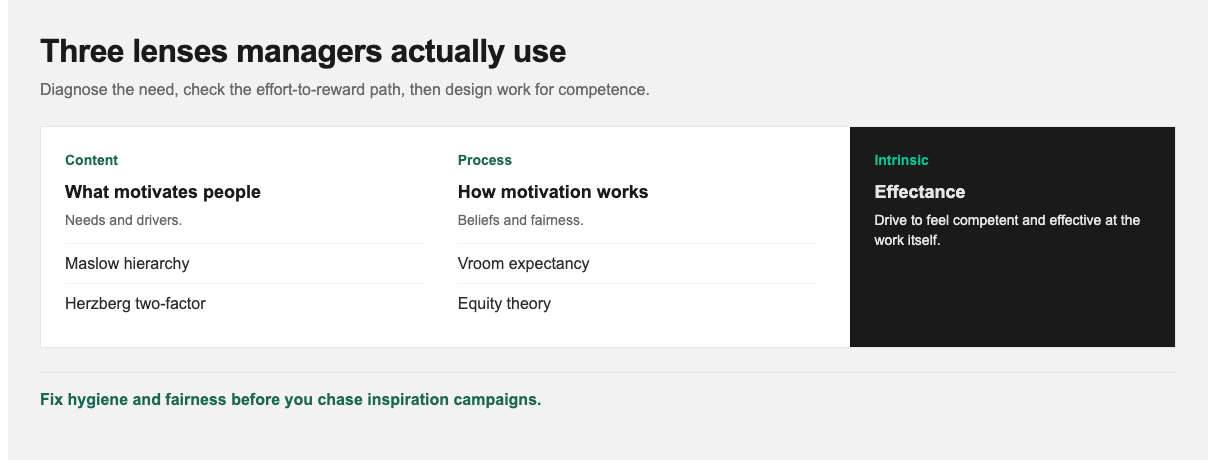
Use content theories to diagnose needs. Use process theories to fix broken effort-to-reward links.
Why Motivation Theory Matters at Work
You cannot motivate a team you do not understand. Different people are driven by different things: security, recognition, achievement, growth, or the simple satisfaction of doing something well. Motivation theories give managers a shared vocabulary and a set of tested models for diagnosing what is really going on and responding effectively.
That is especially useful when a “motivation problem” is actually a fairness problem, a unclear-rewards problem, or a hygiene problem that no pep talk will fix.
Content Theories: What Motivates People
Maslow’s hierarchy of needs
Abraham Maslow proposed that human needs stack in a hierarchy: physiological, safety, belonging, esteem, and self-actualization. People are motivated to satisfy lower needs before higher ones.
At work: fair pay and job security come first. Only then do recognition and growth opportunities truly motivate.
Herzberg’s two-factor theory
Frederick Herzberg split workplace factors into hygiene factors (pay, conditions, policies: their absence demotivates, but their presence does not inspire) and motivators (achievement, recognition, growth: these actively drive engagement).
At work: fixing pay stops dissatisfaction, but meaningful work and recognition are what lift performance.
Process Theories: How Motivation Works
Vroom’s expectancy theory
Victor Vroom argued motivation depends on three beliefs: that effort will produce performance (expectancy), that performance will be rewarded (instrumentality), and that the reward is valued (valence).
At work: motivation breaks down if any link is weak. For example, if people do not believe good work will actually be rewarded, more exhortation will not help.
Equity theory
People compare their effort-to-reward ratio against others’. Perceived unfairness kills motivation fast.
At work: transparency and fairness in rewards matter as much as the rewards themselves.
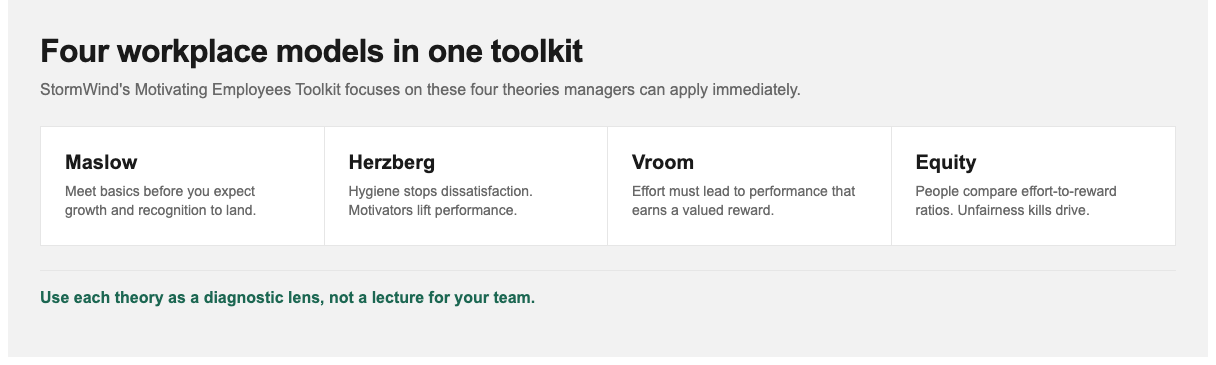
StormWind’s Four Theories of Motivation toolkit covers Maslow, Herzberg, Vroom, and equity.
Effectance: The Drive to Feel Competent
Effectance motivation, introduced by psychologist Robert White, is the intrinsic drive to interact competently with your environment: the satisfaction that comes simply from being effective at something. It underpins much of what we now call intrinsic motivation. People are naturally motivated by mastery, progress, and the feeling of competence, independent of external rewards.
At work: design roles so people can see their own progress and experience mastery. Autonomy, appropriately challenging tasks, and visible progress feed effectance and produce durable, self-sustaining motivation that no bonus can fully replicate.
Applying Motivation Theories as a Manager
- Diagnose first. Use the theories as lenses. Is this a hygiene problem (Herzberg), a fairness problem (equity), or a broken reward link (Vroom)?
- Personalize. People differ. The same lever will not move everyone.
- Build for intrinsic motivation. Effectance and Herzberg’s motivators point to the same truth: meaningful, masterable work beats external carrots over the long run.
- Fix the basics before the extras. Maslow and Herzberg both warn against chasing inspiration while pay, security, or working conditions are broken.
Turn Theory Into Practice
Understanding these theories is step one. Applying them to a real team is where managers add value. StormWind Studios covers this in two focused Business Skills programs: the Four Theories of Motivation toolkit (Maslow, Herzberg, Vroom, and equity) and a deeper module on effectance and motivating experiences. Both sit well alongside our Essential Management Skills course and the companion guide on essential management skills for new managers.
For more information, visit stormwindstudios.com or reach out to [email protected].
Frequently Asked Questions
What are the four main theories of motivation?
A common workplace set is Maslow’s hierarchy, Herzberg’s two-factor theory, Vroom’s expectancy theory, and equity theory. Those are the four covered in StormWind’s Motivating Employees Toolkit.
What is effectance motivation?
The intrinsic drive to feel competent and effective in your environment. It is a foundation of modern intrinsic-motivation thinking.
What is the difference between content and process theories?
Content theories explain what motivates people (needs). Process theories explain how motivation operates (the mental steps from effort to reward).
Can managers really apply these theories day to day?
Yes, as diagnostic tools. You do not need to lecture your team on Maslow. You do need to notice whether the issue is unmet basics, unfair rewards, or weak links between effort and recognition.