What Is the Nominal Group Technique? A Step-by-Step Guide
• Nathaniel Miller
Every team has sat in the meeting where one loud voice dominates, quieter experts stay silent, and the “decision” is really the highest-paid person’s opinion. The nominal group technique (NGT) was built to fix that. It is a structured decision-making method that gives every participant equal weight, surfaces more ideas than open brainstorming, and ends with a clear, ranked group choice.
This guide covers what NGT is, the four steps to run it, how it compares to brainstorming and the Delphi technique, and when it is the right tool for your team.
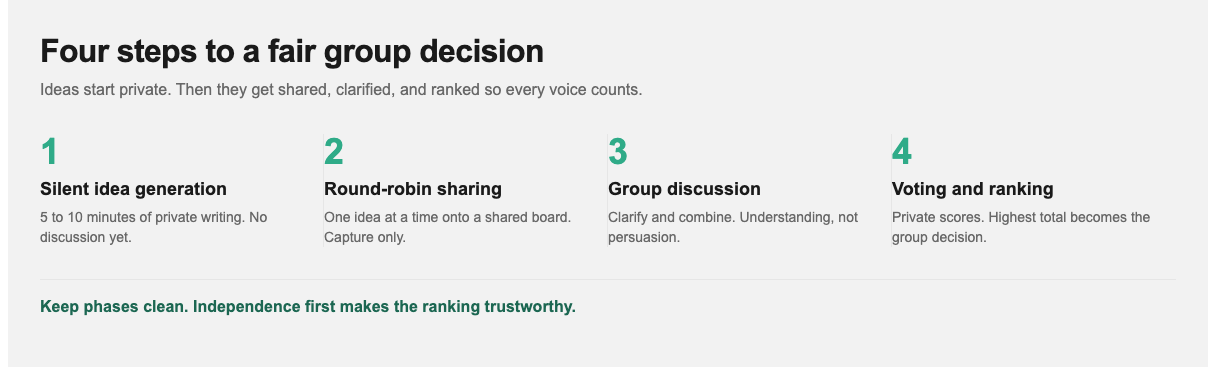
NGT works because ideas start private, then get shared, clarified, and ranked.
What Is the Nominal Group Technique?
The nominal group technique is a structured group process for generating ideas and reaching a decision through individual input followed by silent voting. “Nominal” means the group works as individuals first: people generate ideas on their own before any discussion, which prevents early opinions from anchoring everyone else.
André Delbecq and Andrew Van de Ven developed it in 1971, drawing on social-psychology research into how groups decide. It shows up in healthcare, quality management (it is a recognized Six Sigma tool), education, and business planning whenever you need a defensible ranked outcome in one session.
Why Use NGT Instead of a Normal Meeting?
Open discussion has three problems NGT is built to counter:
- Anchoring / groupthink: the first idea voiced shapes everything after it.
- Social loafing: some members disengage and let others carry the load.
- Dominance: louder or more senior voices crowd out quieter experts.
Because everyone writes ideas privately and votes independently, NGT produces a broader idea set and a decision the whole group has actually shaped. That matters for backlog prioritization, cross-functional initiatives, and any decision where buy-in is as important as the answer itself.
The Four Steps of the Nominal Group Technique
1. Silent idea generation
The facilitator states the question clearly. Each person writes ideas privately, with no discussion, usually for 5 to 10 minutes. This is the “nominal” phase: individuals working in parallel.
2. Round-robin sharing
Going around the group one at a time, each person shares one idea, which the facilitator records on a shared board. No discussion or critique yet, just capture. Continue rounds until all ideas are listed.
3. Group discussion
Now the group discusses the listed ideas: clarifying, combining duplicates, and asking questions. The goal is understanding, not persuasion. Every idea gets airtime regardless of who suggested it.
4. Voting and ranking
Each participant privately ranks or scores the top ideas (for example, picking their top five and assigning points). The facilitator tallies the votes, and the highest-scoring idea is the group’s decision. Because voting is private and mathematical, the outcome reflects the whole group, not the loudest member.
NGT vs Brainstorming vs the Delphi Technique
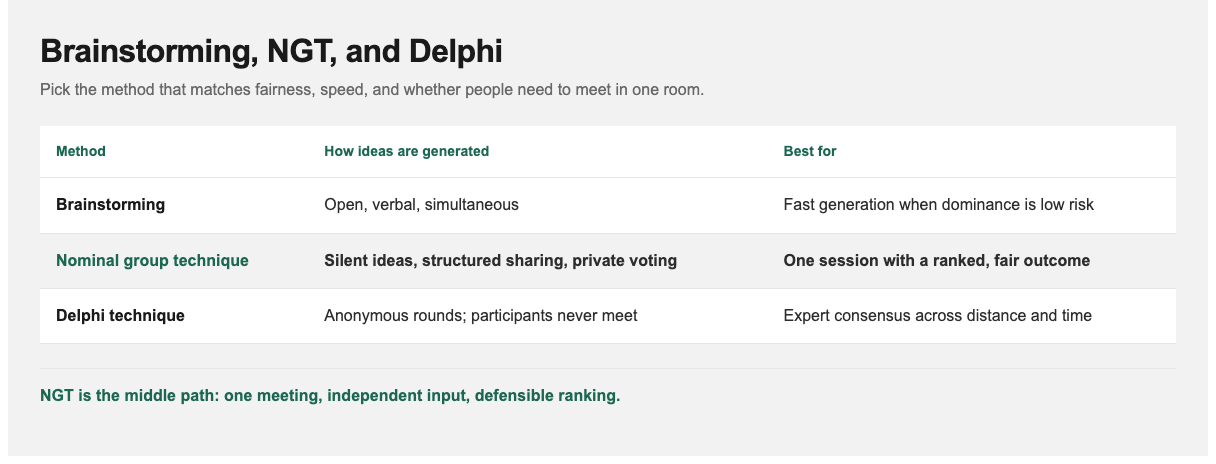
NGT sits between brainstorming speed and Delphi rigor: one session, ranked result.
| Method | How ideas are generated | Best for |
|---|---|---|
| Brainstorming | Open, verbal, simultaneous | Fast idea generation when dominance is not a risk |
| Nominal group technique | Silent and individual, then structured sharing and voting | Fair decisions where every voice must count and you need a ranked outcome in one session |
| Delphi technique | Anonymous, multiple rounds, participants never meet | Expert consensus across distance or time when anonymity matters most |
NGT sits between the speed of brainstorming and the rigor of Delphi. You finish in a single session, but you still preserve independence and produce a ranked result.
When to Use the Nominal Group Technique
- Prioritizing a backlog, initiative list, or set of problems
- Decisions where buy-in matters and a few voices cannot be allowed to dominate
- Cross-functional groups where seniority differences could skew open discussion
- Any time you need a defensible, ranked outcome from a single meeting
When not to use it: trivial decisions (overkill), true emergencies (too slow), or situations that need deep back-and-forth negotiation rather than idea prioritization.
Limitations to Plan For
- Requires a skilled facilitator to keep phases clean
- Works best with roughly 5 to 12 participants (larger groups can split into sub-groups)
- Less spontaneous cross-pollination than open brainstorming
- Usually takes 60 to 90 minutes for a well-scoped question
Build the Skill, Not Just the Agenda
Facilitating NGT well (keeping phases clean and voting fair) is a learnable skill, not a personality trait. StormWind Studios covers it with nominal group technique training: Decision-Making: Groups (Part 5 of 9), a Business Skills lesson on the merits, drawbacks, and step-by-step process in a nine-part group decision-making series. If you are building a broader management foundation, pair it with our Essential Management Skills course and the related guide on essential management skills for new managers.
For more information, visit stormwindstudios.com or reach out to [email protected].
Frequently Asked Questions
Who invented the nominal group technique?
André Delbecq and Andrew Van de Ven, in 1971.
How many people do you need for NGT?
Typically 5 to 12. Larger groups can be split into sub-groups.
Is NGT a Six Sigma tool?
Yes. It is a recognized structured decision-making and prioritization tool in quality management.
How long does an NGT session take?
Usually 60 to 90 minutes for a well-scoped question.
How is NGT different from brainstorming?
Brainstorming generates ideas openly and verbally. NGT starts with silent individual idea generation, then structured sharing, discussion, and private voting so quieter voices count equally.