Waterfall Project Management Explained: Phases, Pros, and Cons
• Nathaniel Miller
Before Agile became the default in software, one methodology ran nearly every large project: waterfall. It is a linear, sequential approach where each phase finishes before the next begins, like water flowing down a series of steps. Decades later, waterfall is far from obsolete. For projects with fixed requirements, strict compliance, or heavy documentation needs, it is often still the right choice.
This guide explains the waterfall model, its phases, its trade-offs against Agile, and how to build waterfall (predictive) project management into a practical skill.
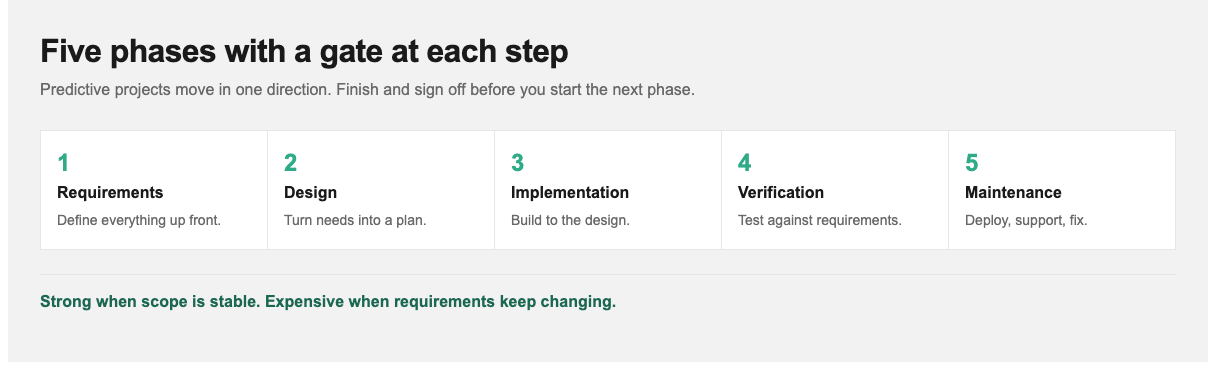
Each phase has clear deliverables and a gate before the next begins.
What Is Waterfall Project Management?
Waterfall project management is a linear, sequential methodology in which a project flows through distinct phases in order, and each phase is completed and signed off before the next begins. Requirements are defined up front, the plan is fixed early, and progress moves in one direction. It is also called the predictive approach because the full scope and timeline are planned in advance.
It was first formally described for software development in the 1970s, but it has roots in manufacturing and construction: industries where you genuinely cannot “iterate” a poured foundation.
The Five Phases of Waterfall
- Requirements: gather and document everything the project must deliver, up front.
- Design: translate requirements into a technical and architectural plan.
- Implementation: build the product according to the design.
- Verification / testing: test against the original requirements.
- Maintenance: deploy, support, and fix issues in production.
Each phase has clear deliverables and a sign-off gate before the next begins. That structure is why waterfall works well for audits, fixed-price contracts, and regulated work.
Waterfall vs Agile
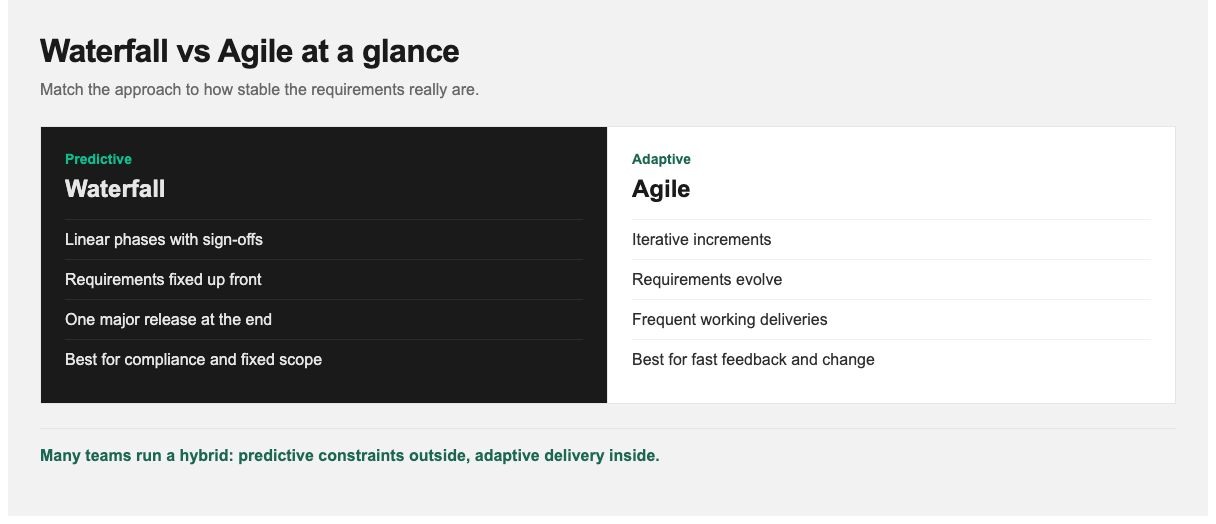
Neither is universally better. Match the method to scope stability and change risk.
| Waterfall (predictive) | Agile (adaptive) | |
|---|---|---|
| Approach | Linear, sequential | Iterative, incremental |
| Requirements | Fixed up front | Evolve throughout |
| Best for | Stable scope, compliance, fixed budgets | Changing requirements, fast feedback |
| Delivery | One release at the end | Frequent working increments |
| Change | Costly once underway | Expected and embraced |
Neither is “better.” They suit different projects. Many organizations run a hybrid of both: predictive planning for fixed constraints, adaptive delivery inside later phases.
Pros and Cons of Waterfall
Pros
- Clear structure and milestones
- Easier to estimate cost and timeline up front
- Strong documentation trail
- Straightforward to manage and audit
- Works well when requirements are stable
Cons
- Inflexible once underway
- Working product appears late
- A requirements error discovered in testing is expensive
- Poor fit for projects with evolving needs
When to Use Waterfall
- Requirements are well understood and unlikely to change
- Regulatory or compliance environments that demand documentation and sign-offs
- Fixed-price, fixed-scope contracts
- Projects with clear, sequential dependencies (construction, hardware, infrastructure rollouts)
If your stakeholders still discover what they want mid-build, Agile or a hybrid will usually serve you better.
Build Predictive Project Management Skills
Formal project-management training gives you a repeatable framework instead of ad-hoc habits. That matters especially for “accidental project managers”: strong individual contributors who suddenly own cost, time, quality, scope, and resources.
StormWind Studios’ waterfall / predictive project management course (PM Fundamentals) is a 7-hour program taught by Ashley Hunt. It covers the core knowledge project managers need to initiate, plan, execute, and monitor and control those competing constraints on real work.
For more information, visit stormwindstudios.com or reach out to [email protected].
Frequently Asked Questions
Is waterfall still used?
Yes, especially in construction, manufacturing, government, and compliance-heavy industries.
Is waterfall better than Agile?
Neither is universally better. Waterfall suits stable, well-defined scope. Agile suits changing requirements and fast feedback.
What does “predictive” project management mean?
It means you plan scope, schedule, and cost in advance and manage against that baseline. Waterfall is the classic predictive approach.
Who should learn waterfall project management?
Anyone leading fixed-scope or compliance-heavy work, including accidental project managers who need a structured method fast.