When AI Is Useful, Risky, or Off-Limits for Project Managers
• Nathaniel Miller
A project manager uploads a vendor contract draft into a public chatbot and asks it to “flag risky clauses.” The model returns confident language about liability caps. Two clauses are wrong. The PM sends the summary to procurement anyway.
That is how AI project management risks show up in real work: not as headline breaches, but as overtrust, bad data, and unclear accountability.
Ashley Hunt covers this pattern in StormWind’s Using AI Without Losing Control: Practical Guidance for Project Managers. The goal is not to ban AI. It is to know when it helps, when it hurts, and when human judgment must lead.
Useful, risky, and off limits are three different decisions. Treat them that way.
Useful: Low-Stakes Drafts You Can Verify
AI is usually worth using when:
- The output is a first draft you will edit (status narrative, meeting summary, workshop agenda).
- You control the input and can redact sensitive details.
- Facts are checkable against your plan, tickets, or calendar.
- Stakes are internal until a human approves external send.
Examples from Ashley’s session themes: brainstorming risks, restructuring bullet notes, drafting communication templates, and comparing option lists you supply.
Risky: High Impact If the Model Is Wrong
Treat these as yellow-light zones. Use AI only with extra verification and clear ownership:
- Schedule and budget figures copied from AI without reconciling to your baseline.
- Compliance or contractual language summarized by a model that cannot read your full agreement.
- Stakeholder-sensitive messaging where tone or omission changes relationships.
- Cross-project data pasted into tools your organization has not approved.
- Decisions presented as “AI recommended” without naming who validated them.
The session calls out accuracy, poor data, privacy concerns, overreliance, and unclear accountability as common pitfalls. Risky use is not always forbidden. It always needs a named reviewer.
Off-Limits: Do Not Outsource These to Public AI
Ashley’s guidance aligns with a simple rule: if the data should not leave your organization, it should not go into a public model.
Keep these off public AI tools:
- HR, payroll, or performance data (even “just to format a report”).
- Customer PII, health information, or regulated records.
- Unreleased financials, M&A details, or security incident specifics.
- Credentials, API keys, or internal system diagrams that expose attack surface.
- Final sign-off on scope, go-live, or contract terms without human authority.
Your PMO or security team may publish a tighter list. When in doubt, ask before you paste.
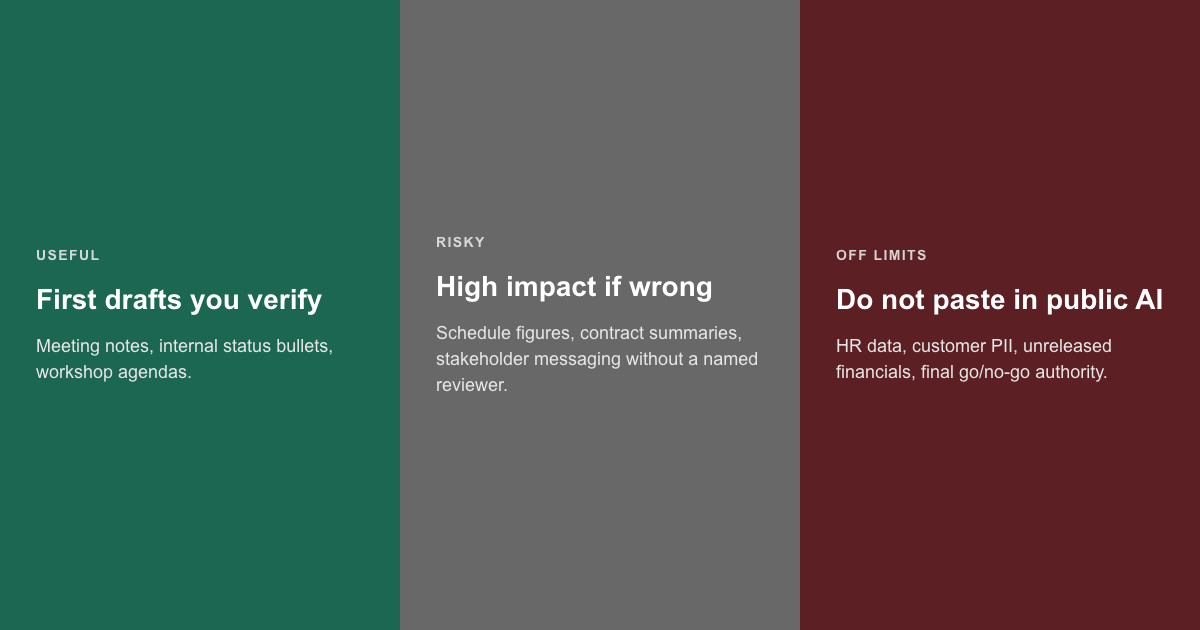
Three zones, one owner: you remain accountable for what the project commits to.
PM Pitfalls Checklist
Use this before you rely on AI output in project work:
- Accuracy: Did you verify names, dates, numbers, and dependencies against source systems?
- Data: Is every pasted field approved for the tool you are using?
- Privacy: Would legal or security object if they saw this prompt?
- Overreliance: Are you skipping stakeholder conversation because the draft “sounds good”?
- Accountability: Who signed off before this left your desk or inbox?
- Tool fit: Is this a public chatbot when your org expects an approved enterprise assistant?
- Audit trail: Can you explain what was AI-assisted if a client or auditor asks?
If any answer is unclear, stop at draft stage until it is clear.
Keep Human Judgment in the Loop
Ashley’s session closes on a practical principle: AI-generated recommendations, reports, summaries, and analysis still need a PM who owns the outcome.
That means:
- Label AI-assisted drafts when your process requires it.
- Never imply the model “decided” a go/no-go.
- Train your team on when not to use AI, not only prompt tricks.
- Pair tool adoption with PMP or PM Fundamentals skills so judgment stays sharp.
Watch the full session
See Ashley walk through practical use cases, risk zones, and accountability in the free on-demand replay:
No form required to play. Optional signup on that page for upcoming webinars on project management and AI for PMs.
Closing
Public AI tools reward speed. Project delivery rewards accuracy, trust, and clear ownership. Use AI where it saves time on drafts you can verify. Draw a bright line where data or decisions do not belong in a model.
If your team is already using AI for status and risk work, run the pitfalls checklist on this week’s outputs. Questions about training paths: [email protected].