10 Essential Management Skills Every New Manager Needs
• Nathaniel Miller
Getting promoted into management is one of the biggest role changes in a career. The skills that made you a strong individual contributor (technical expertise, personal productivity) are not the ones that make you a strong manager. Management is a different job, and it runs on a different skill set.
Here are ten essential management skills that matter most, why each one counts, and concrete ways to develop them.
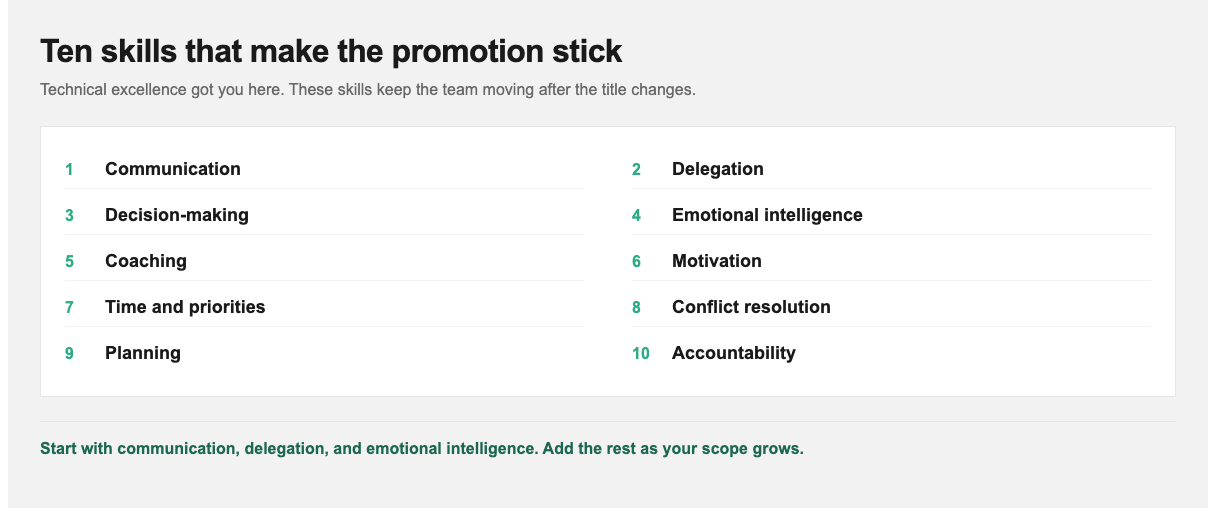
New managers rarely fail on technical knowledge. They stall on people, decisions, and priorities.
Hard Skills vs Soft Skills in Management
Management skills fall into two buckets. Hard skills are teachable, measurable competencies: planning, budgeting, performance management, data-driven decision-making. Soft skills are the interpersonal abilities (communication, empathy, delegation) that determine whether people actually follow you. Great managers need both. New managers most often struggle with the soft side, because nobody taught it before the promotion.
The 10 Essential Management Skills
1. Communication
The single highest-leverage skill. Managers spend most of their day communicating: setting expectations, giving feedback, running meetings, and translating strategy into action.
Develop it: practice one-on-ones, write clearer updates, and ask for feedback on how your messages land.
2. Delegation
New managers often try to do everything themselves. Effective delegation matches tasks to the right people, sets clear outcomes, and then gets out of the way.
Develop it: delegate outcomes, not step-by-step instructions, and resist taking work back.
3. Decision-making
Managers make constant decisions under uncertainty. Strong managers use structured methods to make fair, defensible choices rather than defaulting to gut feel or the loudest voice.
Develop it: learn structured techniques like the nominal group technique for group decisions, and practice separating options from advocacy.
4. Emotional intelligence
Reading the room, managing your own reactions, and understanding what drives your people. High-EQ managers build trust and retain talent.
Develop it: practice active listening and name emotions before reacting.
5. Coaching and development
Your job is no longer to do the work. It is to grow the people who do. Great managers coach, give timely feedback, and create growth paths.
Develop it: run regular development conversations separate from status updates.
6. Motivation
Understanding what actually drives each person, because it is not the same for everyone.
Develop it: learn the core theories of motivation and apply them to your team’s realities, not a one-size-fits-all perk list.
7. Time and priority management
Managers are pulled in many directions. The skill is protecting time for high-impact work and shielding the team from noise.
Develop it: time-block, and ruthlessly distinguish urgent from important.
8. Conflict resolution
Disagreements are inevitable. Unresolved conflict is corrosive. Good managers surface tension early and mediate fairly.
Develop it: address issues directly and privately, focusing on behavior and impact.
9. Planning and organization
Turning goals into realistic plans, sequencing work, and tracking progress.
Develop it: learn a project-management framework and apply it to your team’s initiatives.
10. Accountability
Holding yourself and the team to commitments, consistently and fairly.
Develop it: make commitments visible and follow up without micromanaging.
Management Skills by Career Stage
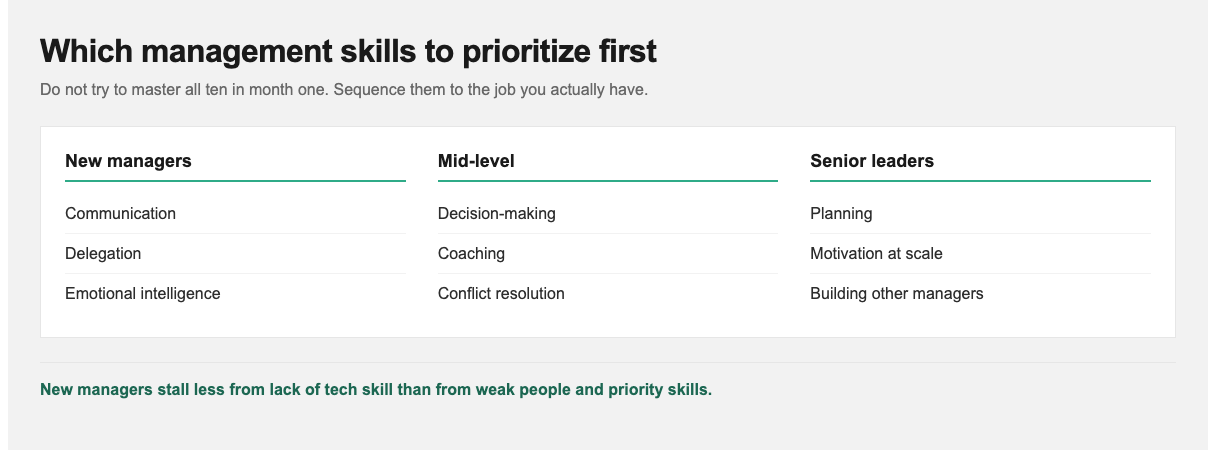
Prioritize the transition skills first. Add scope as your team and stakes grow.
- New managers should prioritize communication, delegation, and emotional intelligence. Those are the transition-defining skills.
- Mid-level managers add decision-making, coaching, and conflict resolution as teams and stakes grow.
- Senior leaders lean on planning, motivation at scale, and building other managers.
How Training Compresses the Learning Curve
Most managers are promoted without formal management training and learn by trial and error, which is slow and costly for the team. Structured training shortens that curve.
StormWind Studios’ Essential Management Skills course is a Business Skills lesson in the Management Basics series. It covers the mix of skills effective managers need, from industry and process literacy to communication, motivation, and critical thinking about how work gets done. For deeper practice on two of the skills above, continue with our nominal group technique training and the Four Theories of Motivation toolkit.
For more information, visit stormwindstudios.com or reach out to [email protected].
Frequently Asked Questions
What are the most important management skills?
Communication, delegation, and emotional intelligence are the highest-leverage skills for new managers.
Can management skills be learned?
Yes. Most are teachable through practice, feedback, and structured training.
What is the difference between leadership and management skills?
Management skills focus on running the work and the team effectively. Leadership skills focus on setting direction and inspiring people. Strong managers need both.
How long does it take to become an effective manager?
It depends on coaching and deliberate practice. Managers who get structured training and feedback usually progress faster than those left to figure it out alone.