Azure Certification Path 2026: Levels, Costs, and Order
• Nathaniel Miller
Microsoft’s Azure certification path is organized into three levels (Fundamentals, Associate, Expert) plus specialty and hybrid credentials. Exams cost about $99 at Fundamentals and about $165 for everything above it. The right starting point depends on whether you are new to cloud or already administering it.
Unlike the older Microsoft program, the current path is role-based: each credential maps to a job, not a product. That makes choosing easier once you know which role you are aiming at. Confirm current exam pricing with Microsoft before you book. Regional pricing varies, and fees change.
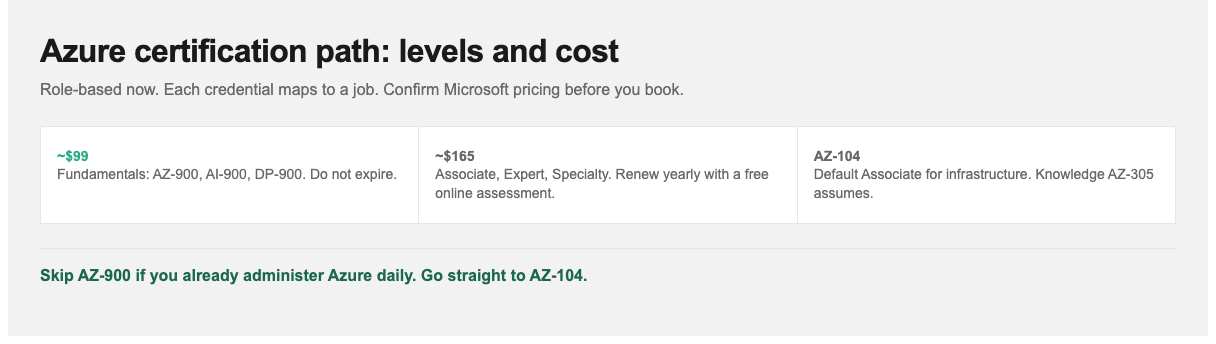
Microsoft does not enforce hard prerequisites. Expert exams still assume Associate knowledge. Most people who skip it struggle.
The Azure Certification Levels
| Level | Purpose | Exam cost (USD) | Prerequisites |
|---|---|---|---|
| Fundamentals | Core cloud concepts and vocabulary | About $99 | None |
| Associate | Role-based hands-on skills | About $165 | None formally; experience assumed |
| Expert | Advanced architecture and DevOps | About $165 | Associate strongly recommended |
| Specialty | Narrow technical domains | About $165 | Varies |
You can technically sit AZ-305 with no prior certification. In practice the Expert exams assume the Associate knowledge.
This guide covers 12 credentials: AZ-900, AI-900, DP-900, AZ-104, AZ-204, AZ-500, AI-102, DP-203, AZ-305, AZ-400, AZ-140, and the AZ-800/AZ-801 hybrid pair.
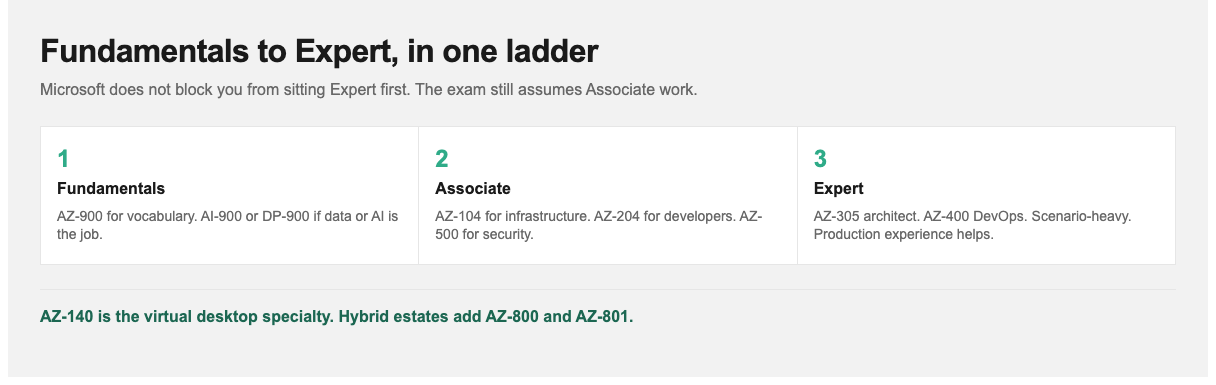
Microsoft will let you sit Expert first. The exam still assumes Associate work.
Fundamentals: Where Most People Start
AZ-900 (Azure Fundamentals) is the entry point: cloud concepts, core Azure services, security, governance, and pricing. No experience required. It is the right first step for anyone who needs shared vocabulary rather than hands-on skill: analysts, project managers, sales engineers, and IT staff new to cloud.
Our AZ-900 guide covers the exam cost, the four domains, and whether it is worth taking if you are already working in cloud.
Two other Fundamentals exams matter depending on direction:
- AI-900 (Azure AI Fundamentals): introductory machine learning and AI services on Azure.
- DP-900 (Azure Data Fundamentals): relational and non-relational data concepts, the entry point to the data track.
Skip Fundamentals if you already administer Azure daily. Go straight to AZ-104. AZ-900 will not teach you anything you do not already know.
Associate: The Career-Defining Tier
This is where certification starts changing which jobs you can get. Each Associate credential maps to a distinct role.
- AZ-104 (Azure Administrator): identity, governance, storage, compute, virtual networking, and monitoring. The most popular Azure certification and the default choice for infrastructure roles.
- AZ-204 (Developing Solutions for Microsoft Azure): building, deploying, and debugging cloud applications. For software developers.
- AZ-500 (Azure Security Engineer): identity and access, platform protection, data security, and security operations.
- AI-102 (Azure AI Engineer): building and deploying AI solutions using Azure AI services.
- DP-203 (Azure Data Engineer): data storage design, processing pipelines, and optimization.
If you are unsure, AZ-104 is the safest bet. It is the broadest, the most recognized by hiring managers, and it is the knowledge AZ-305 and AZ-400 assume.
Expert: For Experienced Cloud Professionals
- AZ-305 (Azure Solutions Architect Expert): designing identity, data storage, business continuity, and infrastructure. Assumes AZ-104 knowledge.
- AZ-400 (DevOps Engineer Expert): CI/CD, infrastructure as code, and release strategy. Requires either AZ-104 or AZ-204 as working knowledge.
Expert exams are scenario-heavy. You are designing solutions under constraints rather than recalling facts. Most candidates need genuine production experience, not just study time.
Specialty and Adjacent Credentials
- AZ-140 (Azure Virtual Desktop Specialty): planning and delivering virtual desktop infrastructure on Azure.
- Windows Server hybrid administration (AZ-800/AZ-801): on-premises Windows Server integrated with Azure. This is a distinct track, and it matters for organizations running hybrid estates. See our AZ-800 and AZ-801 guide, which also covers retirement timing and AZ-802 status.
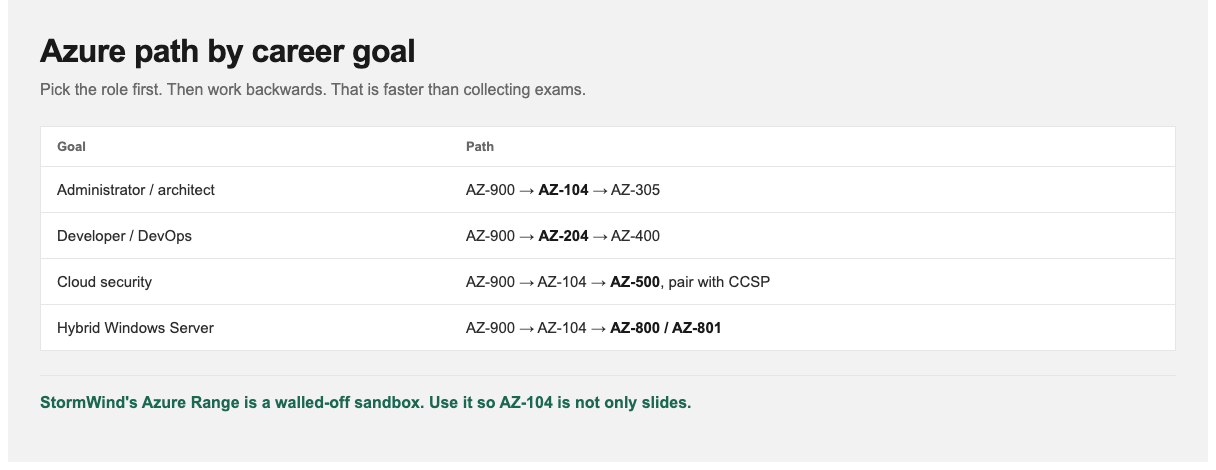
Pick the role first. Then work backwards. Collecting exams and hoping they add up is slower.
The Smartest Route by Career Goal
| Your goal | Recommended path |
|---|---|
| Cloud Administrator | AZ-900 → AZ-104 → AZ-305 |
| Cloud Architect | AZ-900 → AZ-104 → AZ-305 |
| Cloud Developer | AZ-900 → AZ-204 → AZ-400 |
| DevOps Engineer | AZ-104 or AZ-204 → AZ-400 |
| Cloud Security | AZ-900 → AZ-104 → AZ-500 (pair with CCSP for vendor-neutral depth) |
| Data / AI | DP-900 or AI-900 → DP-203 or AI-102 |
| Hybrid infrastructure | AZ-900 → AZ-104 → AZ-800/AZ-801 |
Azure or AWS? A Straight Answer
Certify in whichever platform your employer actually runs. If you have a genuine choice, or you are trying to become platform-flexible, the two programs are structurally similar and the skills transfer more than vendors like to admit.
Azure tends to dominate in enterprises already committed to Microsoft 365 and Active Directory. AWS has a larger share of cloud-native and startup workloads. Our AWS certification path guide lays out the equivalent AWS structure if you want to compare them side by side, and our IT certification roadmap places both within a wider career path.
For security specialists, an Azure or AWS credential paired with a vendor-neutral one is the strongest combination. See best cybersecurity certifications by career stage and our CCSP cost and requirements guide.
Are Azure Certifications Worth It in 2026?
For individuals: yes at Associate level and above. AZ-104 and AZ-305 appear in job requirements frequently enough that holding them changes which roles you can apply for. Fundamentals credentials are useful for career changers and non-technical staff but rarely move salary on their own.
For teams: the value is standardization. When everyone administering your Azure estate shares the AZ-104 baseline, you get fewer misconfigurations, better governance, and a common vocabulary in incident reviews. That is usually a bigger return than any individual credential.
Role-based certifications (Associate, Expert, Specialty) must be renewed annually through a free online assessment. Fundamentals certifications do not expire.
Live Azure Prep and a Place to Practice
Azure moves quickly. Self-paced video recorded eighteen months ago will teach you a portal that no longer looks like that. StormWind runs live, instructor-led Azure training so your team learns the current platform from someone who can answer environment-specific questions. Pair that with the Azure Range: a walled-off sandbox for VMs, VNets, storage, and firewalls without touching production. Start on Azure Range Trailhead if you need the on-ramp.
Start with AZ-900 Microsoft Azure Fundamentals (Will Panek, 13 hours) for teams new to cloud, or go straight to AZ-104 Microsoft Azure Administrator (Mike Pfeiffer, 14 hours) for working administrators. Developers should look at AZ-204 Developing Solutions for Microsoft Azure (Faisal Kahn, 8 hours). Architects should look at AZ-305 Designing Microsoft Azure Infrastructure Solutions (Mike Pfeiffer, 10 hours). For data and AI entry points, DP-900 (David Winegar, 13 hours) and AI-900 are live. If virtual desktop is the job, AZ-140 is 25 hours with Abdel Salem. DevOps engineers can continue into AZ-400. Hybrid Windows Server work is AZ-800 and AZ-801.
Next Steps
Pick the role you want first, then work backwards through the table above. That is faster than collecting certifications and hoping they add up to a career.
Browse the full StormWind course catalog to map a path for your team. For more information, visit stormwindstudios.com or reach out to [email protected].
Frequently Asked Questions
How much do Azure certifications cost?
Fundamentals exams are about $99. Associate, Expert, and Specialty exams are about $165. Regional pricing varies. Confirm with Microsoft before booking.
Which Azure certification should I get first?
AZ-900 if you are new to cloud. AZ-104 if you already administer Azure. AZ-900 will not teach you anything new in that case.
Do Azure certifications expire?
Role-based certifications (Associate, Expert, Specialty) must be renewed annually through a free online assessment. Fundamentals certifications do not expire.
Is AZ-104 hard?
It is a hands-on exam covering identity, storage, compute, and networking. Candidates with six months of practical Azure administration generally find it fair. Those studying purely from video often do not.
Do I need AZ-104 before AZ-305?
Not formally, but AZ-305 assumes that knowledge. Most people who skip it struggle with the design scenarios.
Azure or AWS certification: which is better?
Whichever your organization runs. Both programs are well structured and the underlying cloud concepts transfer between them.