CWNA Certification: Cost, Exam Domains, and Whether It Is Worth It
• Nathaniel Miller
The CWNA certification is CWNP’s base credential for enterprise Wi-Fi. The current exam is CWNA-110, released September 29, 2026. CWNP lists it at $274.99 USD, 90 minutes, and 60 multiple-choice or multiple-answer questions. A score of 70% or higher passes. Instructors must score 80% or higher. The credential is valid for three years.
CWNA-109, the previous version, can still be taken through December 31, 2026. After that date, book CWNA-110. StormWind’s course is the CWNA-109 version, so match the course to the exam you will actually sit. The next update, CWNA-111, is scheduled for September 2029. Confirm the live page on cwnp.com before you pay, because exam details move.
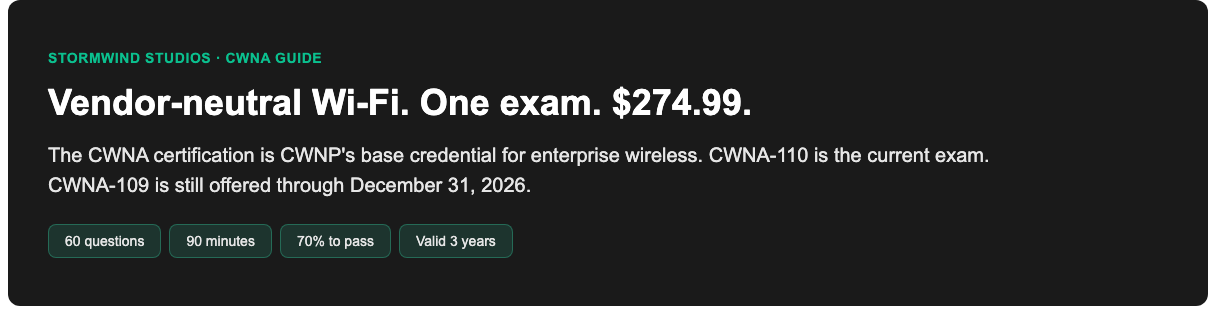
Same credential, two exam versions through the end of 2026. The price on CWNP’s current summary is $274.99.
What Is the CWNA Certification?
Certified Wireless Network Administrator is the foundational enterprise Wi-Fi certification in the CWNP program. It is vendor-neutral. The exam tests 802.11 standards and operations, not one vendor’s dashboard. CWNP describes the job as deploying, managing, monitoring, and doing basic troubleshooting on wireless LANs, and being able to describe how current WLAN devices work.
Passing CWNA earns the certification and is the prerequisite CWNP lists for CWSP, CWDP, CWAP, CWNE, and CWISE. You do not start at CWNE. CWNA is the base. To renew, pass CWSP, CWDP, or CWAP before your CWNA expires, which extends it another three years, or retake the current CWNA exam.
CWNA at a Glance
| Detail | Specification |
|---|---|
| Credential | Certified Wireless Network Administrator (CWNA) |
| Current exam | CWNA-110, released September 29, 2026 |
| Previous exam | CWNA-109, released September 30, 2023. Last day to test: December 31, 2026 |
| Next update | CWNA-111, scheduled for September 2029 |
| Level | Foundational enterprise Wi-Fi |
| Prerequisites | None. CWTS and CWSS are recommended, not required |
| Questions | 60, multiple choice or multiple answer |
| Exam time | 90 minutes |
| Passing score | 70% or higher. Instructors: 80% or higher |
| Cost (USD) | $274.99 on the CWNA-110 exam summary |
| Language | English |
| Delivery | CWNP remote proctored exam |
| Validity | 3 years |
CWNP recommends basic networking (routers, switches, cabling), basic TCP/IP, and at least one year of work with wireless LAN technologies before you attempt the exam. The CWNA-110 objectives also list a CNAE certification or equivalent knowledge. None of that is a formal prerequisite. If you are still sorting out what an access point does, read what a wireless access point is before you buy a voucher.
CWNA-109 or CWNA-110: Which Exam to Book
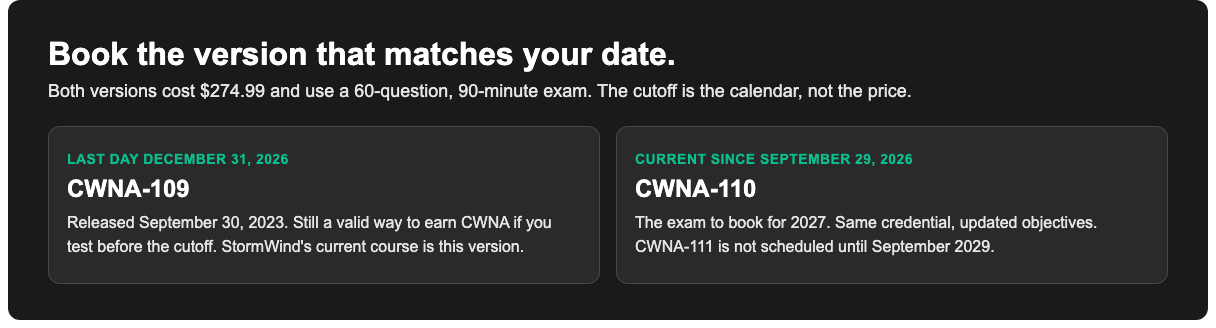
- You can test on or before December 31, 2026, and your study material is CWNA-109. You can still sit CWNA-109. StormWind’s current course is this version.
- You will test in 2027. Book CWNA-110 and study the September 2026 objectives. CWNA-109 will be closed.
- You already hold CWNA. You keep it until it expires. Renew by passing CWSP, CWDP, or CWAP before that date, or by retaking the current CWNA exam.
CWNA-110 keeps the same six domains. The newer outline calls out Wi-Fi 7 (802.11be), Wi-Fi 6E in 6 GHz, multi-link operation, and OFDMA in the standards section. If your notes stop at Wi-Fi 6, they are behind the current exam.
Who Should Take CWNA?
- Network admins who already run the wired LAN and now own the wireless side: access points, controllers, roaming, and the tickets that follow
- Engineers in mixed-vendor sites who need 802.11 skills that are not tied to one manufacturer’s badge
- People aiming at CWSP, CWDP, or CWAP who need the prerequisite first
- Technicians with about a year of WLAN work who can already explain TCP/IP and want the credential to match the job
Skip CWNA if you only need a buying decision between an access point, a router, and an extender. That comparison is in access point vs router vs extender. Skip it as a first IT certification if you do not yet know switching, IP addressing, or cabling. Get that foundation, then come back.
Is the CWNA Certification Worth It?
It is worth it when your work is enterprise Wi-Fi and you want a credential that hiring managers can look up, without locking the study plan to one vendor. The exam fee on the current CWNP summary is $274.99. The credential lasts three years. Passing it is how CWNP says you qualify to continue into security (CWSP), design (CWDP), and analysis (CWAP).
It is a weak use of the fee if you do not touch WLANs, if you need a vendor certification your employer already named, or if you were hoping CWNA was the expert badge. That badge is CWNE, and CWNA is a prerequisite for it, not a substitute. CWNP does not publish a salary for CWNA holders, so this guide will not invent one.
What CWNA Covers
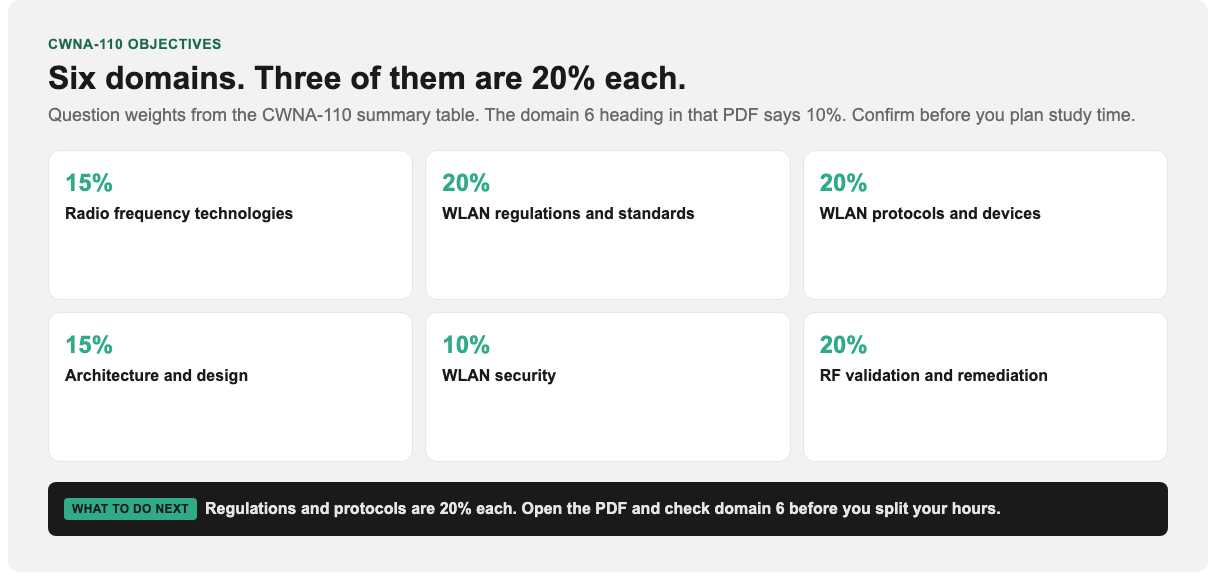
These weights are the question distribution in the CWNA-110 objectives summary table (September 2026). They add up to 100%. The heading on domain 6 inside that same PDF says 10%, not 20%. Open the PDF and use the figure CWNP stands behind before you lock a study schedule. The skill list below follows the CWNA-110 outline either way.
| Domain | Weight | What to be able to do |
|---|---|---|
| Radio frequency technologies | 15% | Wavelength, frequency, amplitude, and phase. Reflection, refraction, diffraction, scattering, multipath, gain, loss, VSWR, and free space path loss. RF math in dBm and mW, including the rules of 10 and 3. Antennas, polarization, MIMO, and how to read azimuth and elevation charts |
| WLAN regulations and standards | 20% | Roles of the IEEE, Wi-Fi Alliance, IETF, and regulators. PHY rates from 802.11 through Wi-Fi 7, including 802.11ax in 6 GHz. OFDMA, MCS, channels, DFS, TPC, and power limits. BSS, ESS, bridging, peer-to-peer, and mesh |
| WLAN protocols and devices | 20% | BSS, SSID, BSSID, ESS, and the distribution system. MAC and PHY frame names, the three frame types, scanning, authentication, and association. DCF, EDCA, and interframe spaces. Access points, controllers, bridges, mesh, and clients |
| Architecture and design | 15% | PoE budgets and power classes. Centralized versus distributed forwarding. Design for data, voice, video, high density, guest access, and legacy clients. DHCP, DNS, time sync, VLANs, and RADIUS as services the WLAN depends on |
| WLAN security | 10% | What not to rely on: WEP, shared key, SSID hiding, MAC filtering, and TKIP. WPA2-Personal limits, WPA2-Enterprise with 802.1X and EAP, WPA3 and SAE, and OWE for guest networks. Protected management frames and rogue detection |
| RF validation and remediation | 20% in the summary table. The section heading says 10%. | Post-install validation of coverage, throughput, roaming, and connectivity. 802.11 contention versus non-802.11 interference. Throughput, VoIP, and spectrum tools. PoE, DNS, DHCP, security mismatches, and hidden nodes as common break points |
How to Prepare
- Pick the exam version before you study. CWNA-109 through December 31, 2026. CWNA-110 after that, and for anyone starting against the September 2026 objectives now.
- Download that version’s objectives from cwnp.com and check the domain 6 percentage. Do not study from a blog table if the PDF disagrees.
- Close gaps in networking and TCP/IP first if you cannot yet explain a switch, an IP address, or a cable fault. The exam assumes that layer.
- Put extra hours on the 20% domains in the summary table: regulations and standards, and protocols and devices. Do the RF math until the rules of 10 and 3 are automatic.
- Practice the security list out loud. Know which options CWNP says do not belong in an enterprise WLAN, then how WPA2-Enterprise, WPA3, and OWE differ.
- Touch the tools at a basic level: a survey or scanner, a protocol analyzer, and a spectrum analyzer. The validation domain is about using them, not naming them.
Do not use brain dumps. CWNP’s objectives say candidates who use unauthorized materials can have the certification revoked, and you have to affirm the conduct policy when you sit the exam.
How StormWind Studios Approaches CWNA Prep
StormWind’s Certified Wireless Network Administrator (CWNA-109) course is built for the CWNA-109 exam. Lessons cover radio frequency, WLAN standards and compliance, wireless protocols, network design, security including WPA3, and troubleshooting. That is the right course if you will sit CWNA-109 before December 31, 2026.
If you will sit CWNA-110, treat the September 2026 objectives as the checklist, especially Wi-Fi 7, 6 GHz, and multi-link operation. Ask StormWind which course version you are enrolling in before you assume the 109 class covers the 110 additions. The credential you earn is still CWNA either way.
Next Steps
Download the objectives for the exam you can actually book. If that exam is CWNA-109 and your date is on or before December 31, 2026, the current StormWind course matches it. If your date is later, study CWNA-110 and confirm the class version first.
StormWind Studios offers instructor-led CWNA-109 training for individuals and teams. Explore the CWNA-109 course, or contact [email protected] for enrollment questions.
Frequently Asked Questions
What is the CWNA certification?
CWNA is the Certified Wireless Network Administrator credential from CWNP. It is the foundational, vendor-neutral exam for enterprise Wi-Fi. Passing it is the prerequisite CWNP lists for CWSP, CWDP, CWAP, CWNE, and CWISE.
How much does the CWNA exam cost?
CWNP’s CWNA-110 exam summary lists $274.99 USD. The exam has 60 questions and a 90-minute limit. Confirm the price at checkout.
What is the difference between CWNA-109 and CWNA-110?
Both earn the same CWNA certification. CWNA-110 became the current exam on September 29, 2026. CWNA-109 can be taken through December 31, 2026. CWNA-110 adds current PHY topics such as Wi-Fi 7, 6 GHz, and multi-link operation. The next version, CWNA-111, is scheduled for September 2029.
Is the CWNA certification worth it?
It is worth the $274.99 fee if you install, manage, or troubleshoot enterprise Wi-Fi and want a vendor-neutral credential that leads to CWSP, CWDP, and CWAP. It is a poor fit if you do not work on WLANs, or if you need CWNE. CWNE is the expert credential, and CWNA is a prerequisite for it.
What is CWNE?
CWNE is CWNP’s expert credential. The CWNA-110 objectives say passing CWNA is a required prerequisite for CWNE. Do not start there. Renew an active CWNA by passing CWSP, CWDP, or CWAP before it expires, or by retaking the current CWNA exam.
How long is the CWNA exam, and what score passes?
CWNP lists 90 minutes and 60 questions for CWNA-110. A score of 70% or higher passes. Instructors must score 80% or higher. Delivery is a CWNP remote proctored exam, in English.
Does CWNA have prerequisites?
No. CWTS and CWSS are recommended, not required. CWNP also recommends basic networking, TCP/IP, and at least one year with wireless LAN technologies. The CWNA-110 objectives mention a CNAE certification or equivalent knowledge as recommended background.