CCNA Certification Cost and Salary in 2026
• Nathaniel Miller
The CCNA certification cost starts at $300 plus tax for exam 200-301. Every retake costs the full $300 again. There is no discounted second attempt, and Cisco typically makes you wait five calendar days after a fail before you can retest. This guide covers the real total, including the line items people forget, what CCNA holders earn, and the payback math.
The sticker price is misleading in both directions. The exam is cheaper than most people expect. The total investment is higher once you add materials, practice exams, and (if you choose it) instructor-led training. Confirm the current exam fee on Cisco’s official exam page before you budget. Vendor pricing changes.
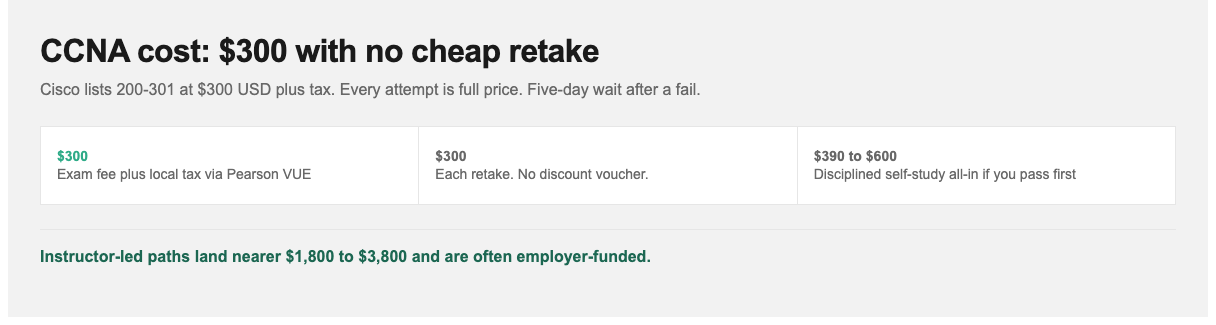
Every attempt is full price. A disciplined self-study path is often $390 to $600 all-in if you pass first.
CCNA Certification Cost at a Glance
| Component | Cost (USD) | Notes |
|---|---|---|
| Exam fee (200-301) | $300 + tax | Cisco’s published price; local tax varies |
| Lab environment | $0 to $500 | Packet Tracer is free |
| Study materials | $40 to $150 | Official cert guide, video courses |
| Practice exams | $50 to $150 | Highest-value optional spend |
| Training (self-paced) | $100 to $600 | Optional |
| Training (instructor-led) | $1,500 to $3,500 | Optional; often employer-funded |
| Retake | $300 per attempt | No discount, ever |
| Recertification (3 years) | Varies | Exam or Continuing Education credits |
Realistic totals: a disciplined self-study candidate spends $390 to $600 all-in. With instructor-led training, budget $1,800 to $3,800.
For how to spend the study hours, see how to study for the CCNA: a 10-week study plan.
The Exam Fee
Cisco lists the CCNA 200-301 at $300 USD plus applicable tax. You book through Pearson VUE, and the amount you actually pay depends on region. Pearson VUE charges in local currency and adds local tax or VAT.
Two things the fee does not include, which candidates sometimes assume: there is no separate certification or registration fee beyond the exam itself, and there is no bundled retake voucher.
Lab Costs: The Line Item People Forget
You cannot pass the CCNA without hands-on practice, because the exam includes simulation questions where you configure simulated devices. Lab access is not optional, but it can be free.
| Option | Cost | Verdict |
|---|---|---|
| Cisco Packet Tracer | Free | Sufficient to pass; resembles the exam environment |
| CML / EVE-NG with real IOS | Moderate + capable hardware | Better for production skills, not required |
| Used physical gear | $150 to $500 | Real console experience; noisy and power-hungry |
| Cloud rack rental | Subscription | Convenient, ongoing cost |
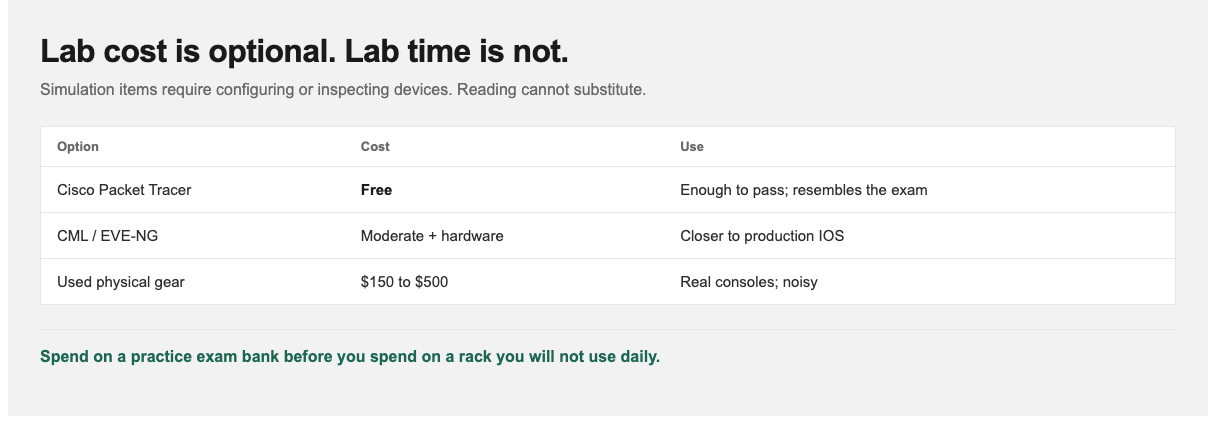
Lab time is required. Lab spend is not. Packet Tracer is free and close enough to the exam.
The correct answer for most candidates is $0. Packet Tracer is free from Cisco and covers nearly everything on the exam. Spending money here before you have exhausted the free option is one of the easier savings available.
Retake Policy and the Real Cost of Failing
This is where CCNA budgets actually break.
There is no discounted retake. Every attempt costs the full $300. Cisco also enforces waiting periods between attempts, typically five calendar days after a failed attempt before you can retest.
The math is straightforward. A $100 practice exam package that prevents one retake returns three times its cost. Spending $150 on quality practice exams to avoid a $300 retake plus five days of lost momentum is the single highest-return decision in a CCNA budget, and it is the one most often skipped.
Recertification
The CCNA is valid for three years. Cisco’s recertification model allows you to renew by passing an exam or by earning Continuing Education credits through Cisco’s program. Specific requirements and credit values change periodically.
Verify current recertification requirements on Cisco’s certification pages rather than relying on secondhand guidance. The practical planning point: budget either an exam fee or the time for continuing education every three years. Passing a higher-level exam (such as a CCNP-level exam) also recertifies the CCNA, which is why many people naturally recertify by progressing to CCNP ENCOR.
CCNA Salary Expectations
Published salary data for CCNA holders varies widely by source, and for good reason: the CCNA spans a wide range of roles. A help desk technician who earned it and a network engineer with five years of experience who holds it are in very different bands.
What can be said with more confidence is the shape of its value:
| Role | Where CCNA sits |
|---|---|
| Help desk / desktop support | Differentiator for promotion into networking |
| Network technician / NOC analyst | Frequently expected or required |
| Network administrator | Baseline credential |
| Network engineer | Assumed; CCNP becomes the differentiator |
| Systems / cloud roles | Useful supporting credential |
Where the CCNA delivers most value is the transition into networking. For someone on a help desk trying to move into a network role, it is often the single most effective credential available. It is widely recognized, employers trust it, and it demonstrably requires real work. Its marginal value declines once you are established, at which point experience and CCNP-level certification matter more.
For current figures, check job postings in your own market rather than national averages. Regional variation in networking roles is substantial, and postings tell you what is actually being paid for the roles you would apply to.
The Payback Math
A self-study CCNA costs roughly $450 all-in (exam, free labs, cert guide, practice exams).
- A $5,000 salary increase pays that back in about five weeks.
- A $10,000 increase, realistic for a help-desk-to-network-role transition, pays it back in about two and a half weeks.
- Even a lateral move with no raise returns the investment in career optionality, since networking roles generally have higher ceilings than general support roles.
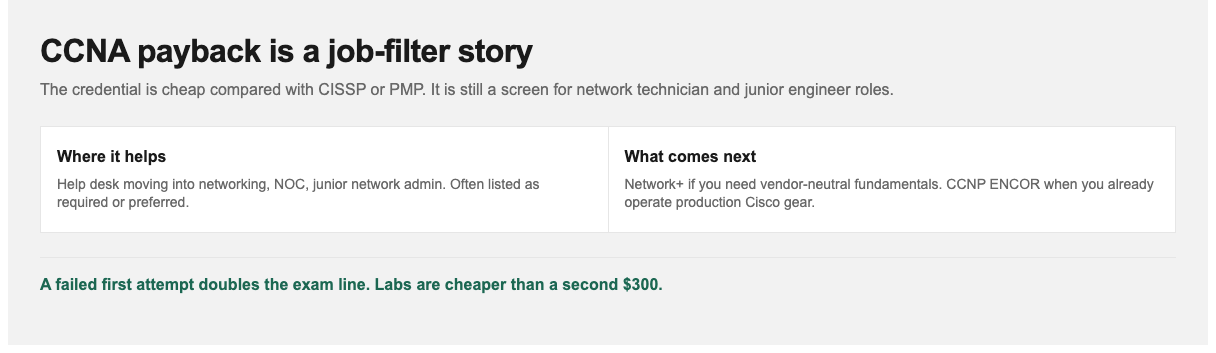
The visible cost is a few hundred dollars. The real spend is 150 to 200 hours of study, which is why first-attempt prep matters more than saving $100 on materials.
There are not many professional investments with this profile. The real cost of the CCNA is not the $450. It is the 150 to 200 hours of study. That is what you are actually spending, and it is why choosing preparation that gets you through on the first attempt matters more than saving $100 on materials.
CCNA vs CCNP: When to Move Up
The CCNA is the associate level. CCNP (Professional) is the next tier, requiring a core exam plus a concentration exam in a specialization such as enterprise, security, or data center.
Move to CCNP when: you have one to three years of hands-on networking experience beyond the CCNA, you have specialized enough to know which concentration you want, you are targeting senior engineer or architect roles, or your employer is funding it. The CCNP is a substantially larger commitment: two exams, materially deeper material.
Stay at CCNA when: you are still consolidating fundamentals, networking is one of several responsibilities rather than your specialization, or you would be pursuing CCNP mainly to collect it. A CCNA with three years of solid hands-on experience is more employable than a CCNP with none.
If you are mapping the whole ladder, Network+ then CCNA then CCNP is the sequence we use in the IT certification roadmap for 2026.
What Employers Should Budget Per Engineer
If you are funding certifications for a networking team:
- Instructor-led path: $2,000 to $3,800 per person. Higher upfront, materially better first-attempt pass rates.
- Supported self-study: $500 to $700 per person. Exam fee, materials, practice exams, plus (critically) protected study time.
Two observations from organizations that do this well. First, fund the practice exams. They cost around $150 and prevent $300 retakes plus lost momentum. Declining them to save money does not actually save money. Second, protected study time is the real budget item. Paying for a $3,000 course and then giving someone no time to study is the most common way certification programs fail. The money is spent and the certification never arrives.
Instructor-Led CCNA Training and First-Attempt Economics
The economics of instructor-led training rest almost entirely on first-attempt pass rates. A $300 retake is the visible cost of failing. The invisible cost is the five-day wait, the lost momentum, and the candidates who fail once and never rebook.
Live delivery addresses the two things that most commonly cause failures: unresolved confusion on subnetting and OSPF, and insufficient hands-on practice under time pressure. An instructor can see where you are stuck rather than waiting for you to identify it yourself. For teams, cohort training also standardizes how your engineers troubleshoot, which pays off long after the exam.
StormWind’s live CCNA 200-301 course is 40 hours of instruction. The Study Plan on that course page includes a Placement Exam, the full course, CCNA Exam Crash (12 hours with Raymond Lacoste), and a Readiness Exam. That combination is built around first-attempt readiness, not another video library.
Budget $450 for a self-study path or $2,000 to $3,800 for instructor-led. Download Packet Tracer free rather than buying lab gear, and do not skip practice exams. They are the cheapest insurance against a $300 retake. Confirm the current exam fee and recertification requirements on Cisco’s official pages before you commit.
For more information, visit stormwindstudios.com or reach out to [email protected].
Frequently Asked Questions
How much does the CCNA cost?
The exam is $300 plus local tax. A realistic self-study total is $390 to $600 including materials and practice exams. With instructor-led training, budget $1,800 to $3,800. Confirm the current fee on Cisco’s exam page.
Is there a discounted CCNA retake?
No. Every attempt costs the full $300, and Cisco enforces a waiting period between attempts, typically five days after a failure.
Do I need to buy lab equipment?
No. Cisco’s Packet Tracer is free and sufficient to pass. Physical gear or real IOS images are better for production skills but are not necessary for the exam.
How long is the CCNA valid?
Three years. You can recertify by exam or through Cisco’s Continuing Education program. Verify current requirements on Cisco’s certification pages, as they change periodically.
Does the CCNA increase salary?
Its largest impact is enabling a move into networking roles, which typically have higher ceilings than general support roles. Once you are established as a network engineer, experience and CCNP-level certification matter more.
Should I get CCNA or CompTIA Network+ first?
Network+ is vendor-neutral and slightly broader on fundamentals. CCNA is Cisco-specific, more hands-on, and more widely requested in networking job postings. If networking is your target, CCNA generally carries more weight with employers. If you have no networking background, Network+ first is the smoother on-ramp.
Is the CCNA worth it in 2026?
Yes, particularly for moving into networking. It remains one of the most recognized entry points to the field, and at roughly $450 self-study the payback period is measured in weeks if it enables a role change.