PMP Requirements in 2026: Do You Actually Qualify?
• Nathaniel Miller
PMP requirements in 2026 are three hard gates: education, documented project leadership experience, and 35 contact hours of formal training. Miss any one of them and PMI will not let you sit the exam, no matter how long you have been “the person who runs the project.”
Most people who fail to get the PMP do not fail the exam. They stall at the application, either because they misjudged whether they qualified, or because they described their experience in a way that triggered an audit they were not prepared for. Both problems are avoidable if you understand the requirements before you start filling in forms.
This guide shows where you stand, how to describe your experience so the application survives an audit, and what to do if you do not qualify yet. Cost is a separate question: see PMP certification cost in 2026. If CAPM is the better first credential, see CAPM vs PMP.
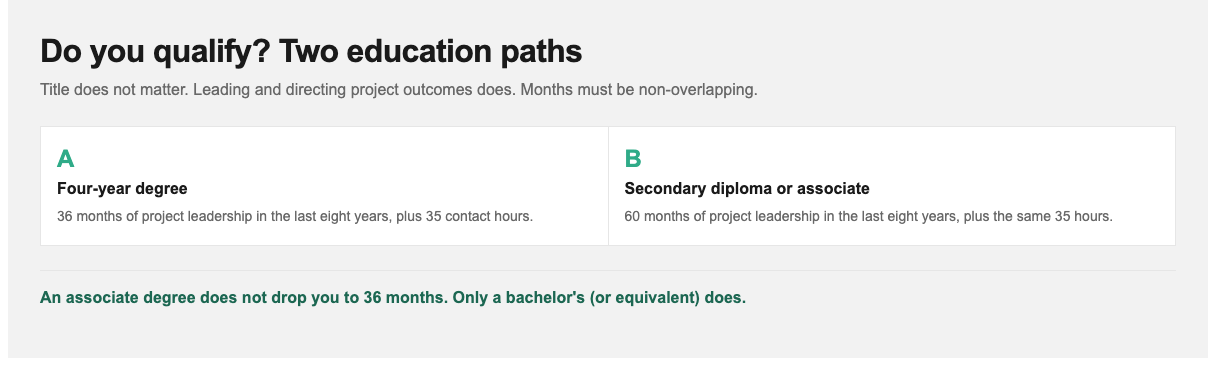
A four-year degree drops the experience bar to 36 months. Without one, you need 60 months. Both paths still require 35 contact hours.
Do You Qualify? Start Here
| Your education | Project leadership experience needed | Contact hours |
|---|---|---|
| Four-year degree (bachelor’s or global equivalent) | 36 months | 35 hours |
| High school diploma, GED, or associate degree | 60 months | 35 hours |
Two things about this table matter more than they appear.
The months must be non-overlapping. If you led two projects simultaneously for a year, that is 12 months of experience, not 24. PMI counts calendar time spent leading projects, not project-months summed.
“Leading and directing” is the operative phrase. You do not need the title “project manager.” You do need to have been responsible for project outcomes (scope, schedule, budget, resources, stakeholders) rather than only executing tasks someone else planned. Team leads, engineers, analysts, and consultants routinely qualify on that definition.
Experience must fall within the last eight years. Older work does not count toward the months, even if it was real project leadership.
Path A: You Have a Four-Year Degree
You need 36 months of project leadership experience within the last eight years. This is the more common path and the shorter one.
A four-year degree in any field qualifies. It does not need to be in project management, business, or engineering. Global equivalents count. PMI accepts international degrees.
If you are in this bucket and already leading work, the remaining gap is usually the 35 contact hours, not the months. That is the piece training is built to close.
Path B: No Four-Year Degree
You need 60 months of project leadership experience, also within the last eight years. An associate degree does not reduce this to 36 months. For PMP purposes it sits in the same bucket as a high school diploma.
Five years sounds daunting, but many candidates on this path have been leading projects informally for longer than they realize. The failure mode is not “not enough work.” It is describing that work as task execution instead of leadership. That is the section that follows.
The 35 Contact Hours
Separate from experience, you must document 35 contact hours of formal project management education. There is no waiver and no experience-based substitute.
Qualifying sources include PMI Authorized Training Partners, university coursework, instructor-led training (live online or in person), documented employer training, and self-paced courses that specify contact hours. On-the-job learning, independent reading, and general leadership courses do not count.
One useful note: these hours never expire. Training you completed years ago still counts, if you can document it. That is why it can make sense to complete a live ATP course now even if you are a few months short on experience. You apply the moment the months cross the line.
StormWind’s PMP Official Exam Prep is PMI ATP official content. It delivers the 35 hours, but the PMI training certificate requires live attendance. Do not plan on a recorded-only path if you need that certificate for the application.
Writing the Experience Section Without Triggering an Audit
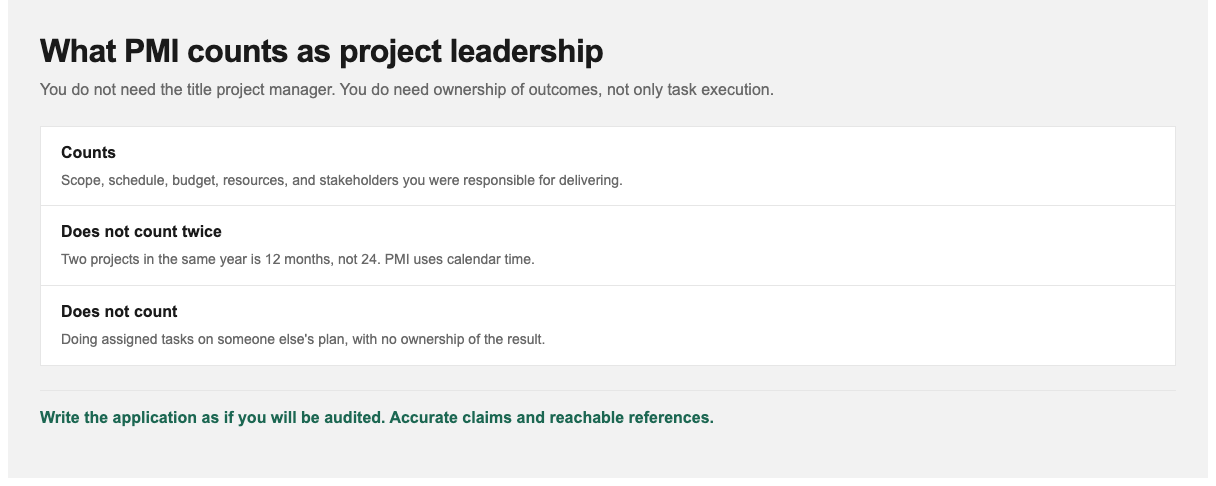
Outcome language and lifecycle vocabulary read as leadership. Task lists read as contribution, even when the work was the same.
This is where applications live or die. PMI asks you to describe each project, and the language you choose determines both whether you are approved and whether you get audited.
What works: describe what you were responsible for, using outcome language and the vocabulary of the project lifecycle.
“Led a 9-month CRM migration for a 40-person sales organization. Defined scope with business stakeholders, built and maintained the schedule, managed a $180K budget, coordinated four vendor resources, and ran weekly status and risk reviews through to go-live and handover.”
What does not work: task lists that describe participation rather than leadership.
“Worked on the CRM migration project. Attended planning meetings, helped test the new system, and trained users.”
The second version might describe the same person doing the same work, but it reads as a contributor, not a leader, and it gives a reviewer no basis to credit the months.
When you write each entry, name the constraint you owned: scope, schedule, cost, quality, resources, or stakeholders. If you cannot name one, that project may not count, and stretching it is how audits go badly.
The Audit: What It Is and How to Survive It
PMI randomly audits a percentage of applications. An audit is not an accusation. It is a verification step, and being selected does not mean you did anything wrong.
If audited, you will be asked to provide:
- Verification of your degree or diploma
- Signatures from supervisors or project sponsors confirming the experience you claimed
- Certificates documenting your 35 contact hours
Two practical precautions. First, list contacts you can actually reach. A former manager who has left the industry and does not answer email will stall your application indefinitely. Second, keep your training certificates. Candidates are far more likely to be tripped up by a missing contact-hours certificate than by a disputed experience claim.
Write the application as if you will be audited. Accurate months, reachable references, and a certificate you can produce in one email.
Timeline: Application to Exam Day
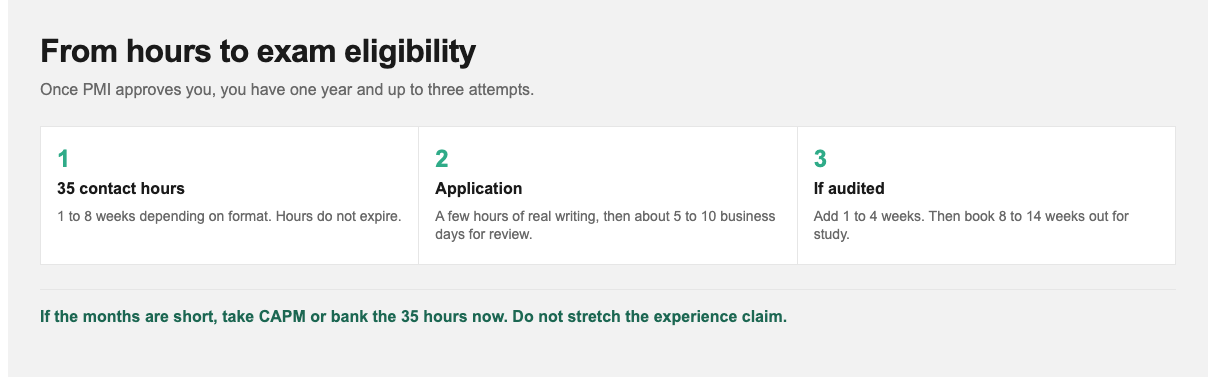
Plan 35 contact hours first. PMI review is typically 5 to 10 business days. Once approved, you have one year and up to three attempts.
| Stage | Typical duration |
|---|---|
| Completing 35 contact hours | 1 to 8 weeks depending on format |
| Filling in the application | 2 to 6 hours of real work |
| PMI review | About 5 to 10 business days |
| Audit, if selected | Add 1 to 4 weeks |
| Eligibility window once approved | 1 year, up to 3 attempts |
Once approved, you have a full year to sit the exam. Most candidates schedule 8 to 14 weeks out to allow for structured study. A realistic 12-week PMP study plan fits inside that window without burning the whole year.
If You Don’t Qualify Yet
You have two good options and one bad one.
Good: take the CAPM instead. PMI’s entry-level project management certification requires a secondary diploma and 23 contact hours. There is no experience requirement. PMI removed the experience option in August 2024, so everyone now comes through education hours. CAPM is a real credential, employers recognize it, and it shows commitment while you accumulate the months you need for the PMP. StormWind’s CAPM Official Exam Prep covers those 23 hours. Full breakdown: CAPM certification in 2026.
Good: get the 35 contact hours now. They do not expire. Completing live ATP training while you build experience means you are application-ready the moment you cross the months threshold.
Bad: stretching the experience claim. Overstating months or inflating your role is precisely what audits catch. A rejected application is a much worse outcome than waiting two quarters.
If the work you lead is mostly predictive (fixed scope, sign-off gates, compliance), the 7-hour waterfall / predictive project management course is a useful skills foundation. It does not replace the 35 PMP contact hours.
PMP Official Exam Prep at StormWind Studios
StormWind Studios is a PMI Authorized Training Partner. PMP Official Exam Prep uses PMI official content, aligned to the PMBOK Guide 8th Edition and the exam’s People, Process, and Business Environment domains.
What learners actually get:
- 35 contact hours, with the PMI certificate tied to live attendance
- Ashley Hunt as instructor across 8 live days, plus mastery
- A PMP application tutorial, which is the part self-study almost never covers well
- An 11th Hour Review before exam week
- The Agile Practice Guide, because roughly half the exam spans agile and hybrid delivery
The practical advantage of live instruction shows up in the application, not just the exam. Candidates routinely arrive unsure whether their experience qualifies or how to describe it. An instructor who has read hundreds of these can tell you in minutes what would take weeks to work out from forum threads. For L&D, that means fewer stalled applications and fewer people who complete training and then never sit the exam.
Next Steps
Work out which education path applies to you, add up your non-overlapping months of project leadership, and confirm you can document 35 contact hours. If all three line up, apply. If the months are short, start the CAPM or bank your contact hours now.
StormWind Studios offers live, instructor-led PMP Official Exam Prep and CAPM exam prep for individuals and teams. Contact [email protected] for enrollment or team training.
Frequently Asked Questions
Do I need to be a project manager by title to qualify for the PMP?
No. PMI requires that you led and directed projects, not that you carried a specific title. Team leads, engineers, analysts, and consultants routinely qualify if they were responsible for project outcomes.
Does an associate degree reduce the experience requirement?
No. Only a four-year degree drops the requirement from 60 months to 36. An associate degree falls under the secondary-diploma path.
Can overlapping projects count twice?
No. PMI counts non-overlapping calendar months. Two concurrent projects over one year is 12 months, not 24.
How likely is an audit?
PMI audits a random subset of applications. It is uncommon but entirely possible, so apply as though you will be audited: accurate claims and reachable references.
Do the 35 contact hours expire?
No. Training completed years ago still counts as long as you can document the hours.
Should I take the CAPM first if I already qualify for the PMP?
Generally no. If you qualify for the PMP, go straight for it. It carries substantially more weight with employers. CAPM is the right move when the months are not there yet. Compare the two in CAPM vs PMP.