CAPM Certification in 2026: Requirements, Cost, and Is It Worth It?
• Nathaniel Miller
PMI removed the 1,500-hour experience option from the CAPM in August 2024. The CAPM certification now requires a secondary degree and 23 contact hours of project management education. No project hours. That is the whole eligibility bar, and a lot of older guides still list the old path.
The CAPM is PMI’s entry-level project management credential: the same organization behind the PMP, with a fraction of the requirements. It is built for people who want into project work but cannot yet sit the PMP: students, career changers, and coordinators who move work along without formally leading it.
If you already qualify for the PMP, skip this credential and go straight there. If you do not, the CAPM is now the clean starting point.
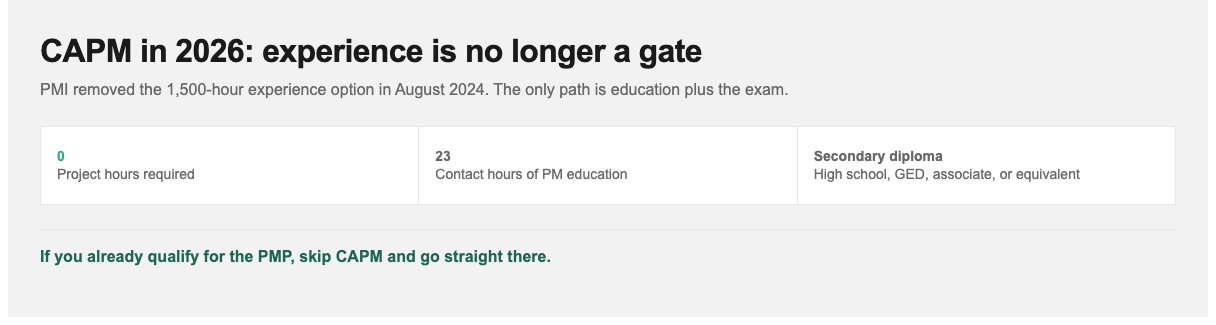
PMI dropped the 1,500-hour path in August 2024. Education is now the only route in.
What Changed in August 2024
Previously, CAPM candidates could qualify one of two ways: 23 contact hours of education, or 1,500 hours of documented project experience. PMI eliminated the experience option.
That sounds stricter. In practice it made the credential easier to plan for. The 1,500-hour path only helped people who already had substantial project exposure. Now there is one deliberate route anyone can complete: finish 23 hours of training, sit the exam.
For students, career changers, and anyone with no formal project history, the CAPM went from a maybe to the obvious first PMI credential.
CAPM Requirements in 2026
| Requirement | Detail |
|---|---|
| Education | Secondary degree: high school diploma, GED, associate degree, or global equivalent |
| Project management education | 23 contact hours, completed before your exam date |
| Project experience | None required (option removed August 2024) |
Compare that with the PMP’s 36 to 60 months of documented project leadership, and the accessibility gap is the reason this credential exists. If you are unsure whether those PMP months actually count, read PMP requirements in 2026 before you pick a path. The side-by-side decision is in CAPM vs PMP below.
The 23 Contact Hours
This is now your only substantive prerequisite, so get the source right. Qualifying hours typically come from:
- PMI Authorized Training Partners
- University or college project management coursework
- Instructor-led training, live online or in person
- Documented employer training programs
- Self-paced courses that specify contact hours
What does not count: work experience, independent reading, general business or leadership courses that are not specific to project management, and any training without documented hours.
Complete the hours before your exam date, and keep the certificate. PMI can ask for it.
StormWind Studios’ CAPM Official Exam Prep is live official exam prep that completes the required 23 contact hours/PDUs. You do not take a separate eligibility course and then a second prep course. The same program covers both.
CAPM Exam Format
| Detail | Specification |
|---|---|
| Questions | 150 multiple choice |
| Time | 3 hours |
| Delivery | Pearson VUE test center or online proctored |
| Validity | 3 years |
The current exam covers four domains:
- Project management fundamentals and core concepts
- Predictive, plan-based methodologies
- Agile frameworks and methodologies
- Business analysis frameworks
Agile and business analysis each get their own domain. The modern CAPM is not a waterfall-only exam. Candidates who study from older materials are the ones most likely to be surprised.
CAPM Cost
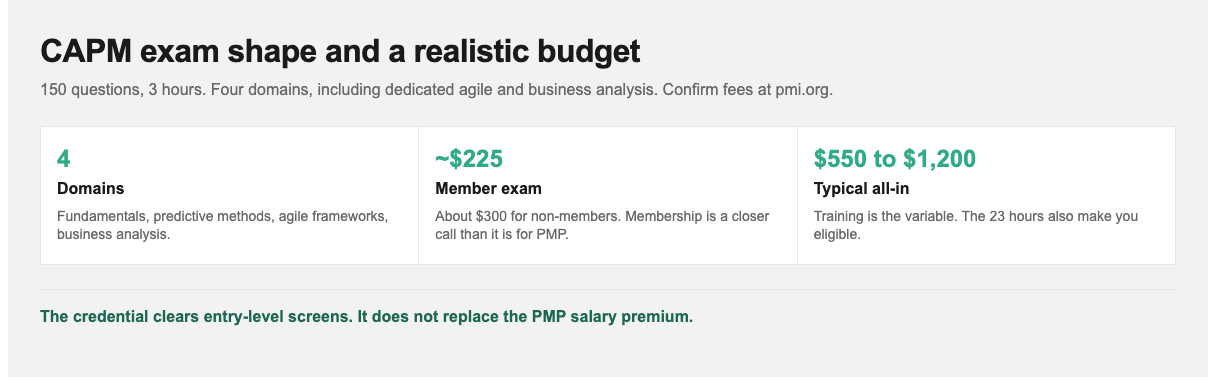
Membership is optional for CAPM. The exam discount is smaller than it is for the PMP.
| Component | PMI member | Non-member |
|---|---|---|
| PMI membership (annual, optional) | $139 to $159 | skip if you are not joining |
| CAPM exam fee | ~$225 | ~$300 |
| 23 contact hours of training | $200 to $800 | $200 to $800 |
| Study materials | $0 to $150 | $0 to $150 |
| Realistic all-in | $550 to $1,200 | $500 to $1,250 |
Confirm current fees at pmi.org before you budget. PMI raised PMP exam fees on August 6, 2026 (now $445 member / $675 non-member) and reviews pricing across its certification portfolio. CAPM fees have not moved in lockstep, but they are not frozen either.
Unlike the PMP, PMI membership is a closer call for CAPM candidates. The exam discount is smaller. Join if you expect to pursue the PMP later or want PMBOK access. Skip it if the CAPM is your only near-term goal. For the full PMP fee stack, see PMP certification cost in 2026.
CAPM Salary Expectations
Published estimates place CAPM holders in the US roughly in the $65,000 to $90,000 range, depending on location, role, and prior experience. Treat that range carefully: it reflects the jobs CAPM holders hold, not a premium the certification creates by itself.
The CAPM’s real value is different from the PMP’s. It does not command a 30% salary bump. It gets your application read. For entry-level project coordinator, project analyst, and associate project manager roles, it is the credential that separates someone who has demonstrated commitment from someone who has only expressed interest.
If salary impact is the main question, compare that with what the PMP is actually worth in 2026.
Is the CAPM Worth It?
If you are a student or recent graduate: yes. This is the strongest case. You have no experience to show, and the CAPM is now achievable with no experience. It signals genuine intent, teaches vocabulary you will be expected to know, and distinguishes your CV in a pile of identical entry-level applications.
If you are changing careers: yes, usually. Career changers have relevant capability and no relevant credentials. The CAPM addresses that gap. The training also counts toward project management education, and you will be building PMP-qualifying experience while holding a credential that helped you get the role.
If you already qualify for the PMP: no. Skip it and take the PMP. It carries substantially more weight, and the CAPM adds little once you hold it. The only exception is wanting an early credential while you still accumulate months. Even then, banking your 35 PMP contact hours is often the better move.
The CAPM to PMP Path
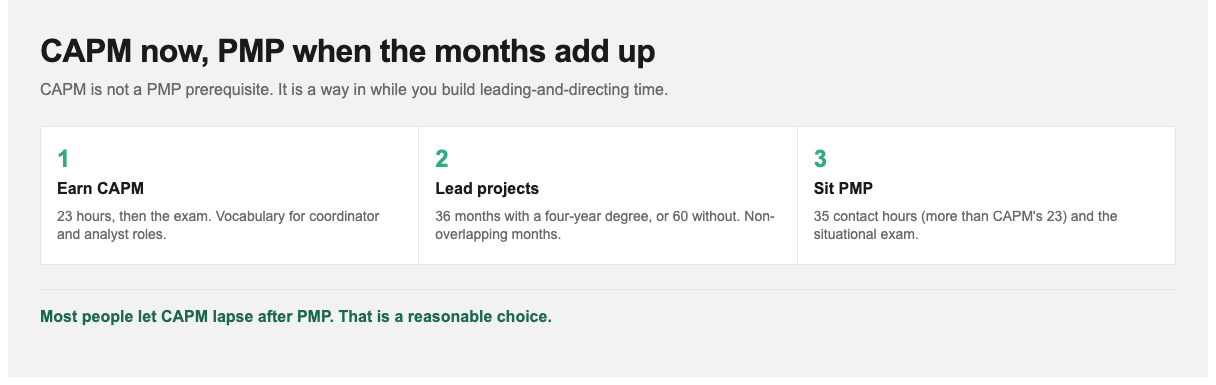
The CAPM is not a PMP prerequisite. It is a way into the role where you will earn the months.
The CAPM is not a prerequisite for the PMP. You can go straight to the PMP whenever you qualify. Sequencing them still works well when you cannot sit the PMP yet:
- Earn the CAPM to enter the field and clear entry-level screens.
- Accumulate project leadership experience: 36 months with a four-year degree, 60 without.
- Complete 35 contact hours (the PMP requires 35, more than the CAPM’s 23).
- Sit the PMP once you qualify.
CAPM contact hours do not automatically satisfy the PMP education requirement. The PMP needs 35 hours. CAPM training can count toward that total if it is documented, but you will still need to close the gap.
CAPM renewal requires PDUs on a three-year cycle, so if you are heading toward the PMP you will maintain two credentials for a period. Most people let the CAPM lapse after earning the PMP. That is a reasonable choice.
For study pacing on the PMP side, use a realistic 12-week PMP plan. For how PM fits a broader IT path, see the IT certification roadmap for 2026.
How to Prepare
The CAPM is more knowledge-based than the PMP’s judgment-based format. It asks what things are more than what you would do. That makes it more tractable, and it means terminology precision matters.
Budget 40 to 80 hours of study on top of the 23 contact hours, or roughly 6 to 10 weeks part-time. Cover all four domains rather than concentrating on predictive methodology, which is the most common preparation error. Use practice questions to check terminology recall, and do not neglect the agile and business analysis domains.
If you have never run a project and the vocabulary feels abstract, PM Fundamentals: Waterfall / Predictive Project Management (Ashley Hunt, 7 hours) is a shorter way to learn the linear, gated approach before you sit a PMI exam.
How StormWind Studios Prepares CAPM Candidates
StormWind’s Certified Associate in Project Management (CAPM) Official Exam Prep is live instructor-led training that completes the 23 contact hours PMI now requires.
The program runs 8 live days plus mastery. It covers fundamentals, business analysis, stakeholders, emotional intelligence, procurement, scope, quality, risk, schedule, integration, and agile, plus formulas, critical path, and the Agile Practice Guide.
That mix matters for CAPM candidates, who often have no project management background. Terminology that is obvious to a working project manager (the difference between a milestone and a deliverable, why a change request follows a defined path) needs to be taught rather than assumed. Live instruction is where you can ask the basic question you would otherwise guess at.
If you already qualify for the PMP, the better investment is PMP Official Exam Prep: PMI ATP content, 35 contact hours, taught by Ashley Hunt. The completion certificate PMI accepts requires the live delivery, not a self-paced substitute.
Next Steps
If you have a high school diploma, you are eligible for everything except the 23 contact hours. That is the remaining task. Complete the training, book the exam while the material is fresh, and confirm current fees at pmi.org.
For enrollment or team CAPM and PMP prep, contact [email protected].
CAPM vs PMP: Which Should You Start With?
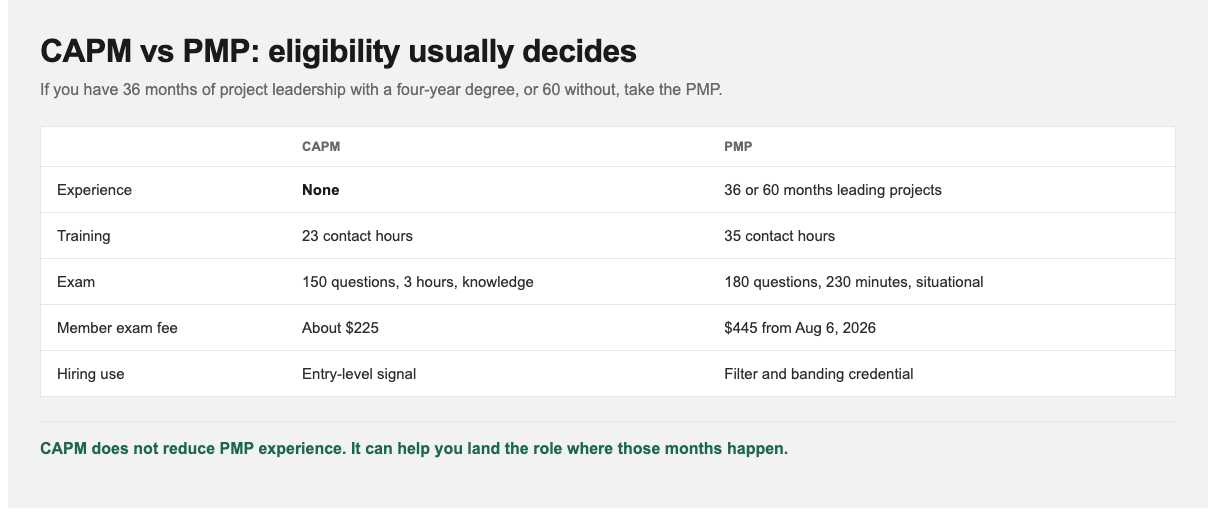
If you already qualify for the PMP, take it. If you do not, the CAPM is the start.
People frame this as a strategic choice: which credential is better positioned, which employers prefer. In practice, most people asking cannot sit the PMP yet, which makes the comparison moot.
The PMP’s experience requirement is strict in a specific way. The months must be non-overlapping, and they must involve leading and directing projects rather than contributing to them. Two concurrent projects for a year is twelve months, not twenty-four. Executing tasks someone else planned generally does not count, even over many years.
Do you have 36 or more months of project leadership experience (with a four-year degree), or 60 or more months (without one)?
- Yes: take the PMP. It carries considerably more weight, and the CAPM adds little once you hold it.
- No: take the CAPM. Since August 2024 it requires no experience at all: a secondary degree and 23 contact hours of training.
Check eligibility first, then choose. PMP requirements in 2026 walks through what PMI actually counts.
Same issuing body, different jobs: the CAPM clears entry screens, the PMP is a hiring filter.
| CAPM | PMP | |
|---|---|---|
| Level | Entry-level | Experienced practitioner |
| Education required | Secondary degree | Secondary degree or four-year degree |
| Experience required | None | 36 months (degree) / 60 months (no degree) |
| Training required | 23 contact hours | 35 contact hours |
| Exam | 150 questions, 3 hours | 180 questions, 230 minutes |
| Question style | Knowledge-based | Situational judgment |
| Exam fee (member) | ~$225 | $445 |
| Exam fee (non-member) | ~$300 | $675 |
| Renewal | 3 years, PDUs required | 3 years, 60 PDUs |
| Study time | 40 to 80 hours | 100 to 150 hours |
| Salary impact | Clears entry-level screens | ~30% premium reported by PMI |
PMP fees reflect PMI’s increase effective August 6, 2026. Confirm current pricing at pmi.org. Full fee detail lives in PMP certification cost in 2026. CAPM exam fees, domains, and the August 2024 eligibility change are earlier in this guide.
Who should take the CAPM first
- You are a student or recent graduate. The strongest case. No experience needed, and it differentiates you in entry-level applications.
- You are changing careers. It addresses the exact gap career changers face: capability without credentials.
- You coordinate projects without leading them. Business analysts, project coordinators, and team members whose experience would not satisfy PMI’s “leading and directing” test.
- Your employer wants a shared framework across a broader group. Cheaper and faster to deploy across coordinators and analysts than the PMP.
Who should go straight to the PMP
- You already qualify. The clearest case. The PMP’s recognition and salary impact are substantially greater. Earning the CAPM first delays that for no real gain.
- You are targeting government or defense work. The PMP appears as a hard requirement in contracts and postings. The CAPM generally does not substitute.
- You are aiming for senior PM or PMO roles. These filter on the PMP. The CAPM will not clear those screens.
Moving from CAPM to PMP later
Partially, and less than people assume.
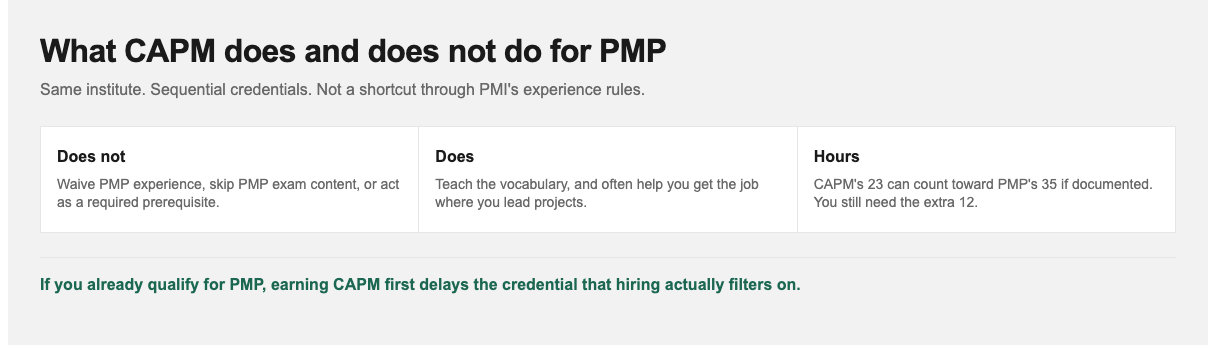
It does not: reduce the PMP’s experience requirement, waive any part of the PMP exam, or serve as a prerequisite. The PMP has no certification prerequisites at all.
It does: give you the vocabulary and framework that make PMP study meaningfully easier, and often help you land the role where you will accumulate qualifying experience. That role is the actual bottleneck.
Contact hours do not transfer as a one-for-one credit. The CAPM requires 23 hours. The PMP requires 35. You will need to satisfy the PMP education requirement separately, though training completed for the CAPM can count toward it if documented. The sequence is in The CAPM to PMP Path above.
For study volume on the PMP side, see how long to study for the PMP.
Frequently Asked Questions
Do I need project experience for the CAPM?
No. PMI removed the 1,500-hour experience option in August 2024. You need a secondary degree and 23 contact hours of project management education. Nothing else.
How much does the CAPM cost?
The exam is approximately $225 for PMI members and $300 for non-members. All-in with training and materials, budget $500 to $1,250. Confirm current fees at pmi.org.
Is the CAPM harder than the PMP?
No. The CAPM is entry-level and more knowledge-based. The PMP is situational and tests applied judgment. The CAPM is meaningfully easier to prepare for.
Is the CAPM respected by employers?
For entry-level project roles, yes. It is issued by PMI, the same body behind the PMP. It will not substitute for experience in senior hiring, but it reliably clears entry-level screening.
How long does the CAPM take to prepare for?
Typically 40 to 80 hours of study on top of the 23 contact hours of required training, or roughly 6 to 10 weeks part-time.
Does the CAPM expire?
Yes. It is valid for three years and requires PDUs to renew.
Should I get the CAPM if I plan to get the PMP eventually?
Only if you do not yet qualify for the PMP. If you do qualify, go straight to the PMP.
Should I get the CAPM or the PMP?
Take the CAPM if you don’t yet meet the PMP’s experience requirement: 36 months leading projects with a four-year degree, or 60 months without one. If you already qualify for the PMP, go straight to it; the CAPM is not a prerequisite.