PMP Salary in 2026: What the Certification Is Actually Worth
• Nathaniel Miller
PMI’s own salary research puts certified project managers roughly 30% ahead of their uncertified peers in the United States. That is the PMP salary headline. It is directionally useful, and it is not a promise that your offer letter moves 30% the week you pass.
For an individual, “is the PMP worth it?” is about salary and mobility. For an employer funding certifications, it is about delivery outcomes, bid eligibility, and whether the training budget returns anything measurable. Both deserve a straight answer, including the cases where the PMP does not move the needle much.
This guide breaks the premium down by industry, region, and experience level, then runs the payback math against what the credential actually costs. For the fee table, see PMP certification cost in 2026. Confirm you meet PMP requirements before you treat any of these numbers as yours.
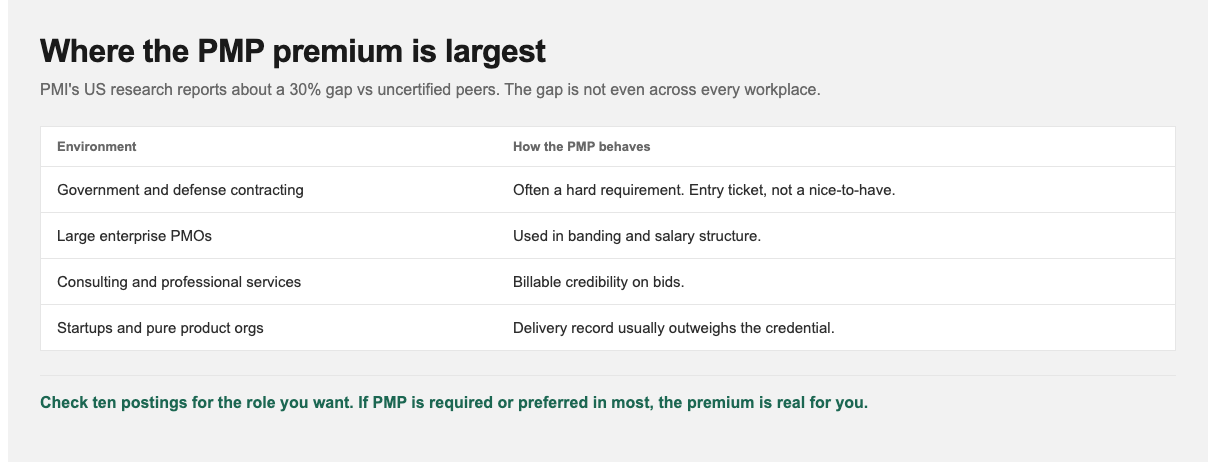
PMI reports a certification premium of around 30% or more in the US. The gap is largest where PMP is a hiring filter, not a nice-to-have.
The Headline Number
PMI conducts a global salary survey across dozens of countries, and the finding it reports consistently is a certification premium of around 30% or more for PMP holders versus non-holders in comparable roles in the US market.
Two caveats, because most articles skip them:
Correlation is not entirely causation. People who pursue the PMP tend to be more experienced and more career-motivated to begin with. Some of that 30% reflects who gets certified rather than what certification does.
The premium is not evenly distributed. It is largest where the PMP functions as a screening credential and smallest where it does not. Knowing which situation you are in matters more than the average.
Where the Premium Is Largest
The PMP moves compensation most in environments where it is treated as a gate:
- Government and defense contracting. Frequently a hard requirement written into contracts and job postings. Here the PMP is not a differentiator. It is the entry ticket.
- Large enterprise PMOs. Formal project management functions often use the PMP as a banding criterion, which puts it directly into salary structure.
- Consulting and professional services. Certifications are billable credibility. Firms bidding on work benefit from certified staff.
- Construction, engineering, and infrastructure. Long-established project management discipline and formal credential expectations.
- Healthcare and financial services IT. Regulated, audit-heavy environments where documented process discipline is valued.
If you work in one of those five, the salary case is usually easy to make to a manager or to yourself.
Where It Matters Less
This section belongs in the same guide.
- Early-stage startups. Small teams typically value demonstrated shipping over credentials. A PMP rarely changes an offer here.
- Pure agile product organizations. Where delivery runs through product managers and scrum roles, agile-specific certifications or a strong track record often carry more weight. The current PMP does cover agile and hybrid, so this is not “waterfall only.” It is still not always the credential that product orgs screen on.
- Very senior leadership. At director and VP level, your portfolio outweighs your credentials. The PMP helps you get to that level more than it helps once you are there.
The pattern: the PMP is most valuable where it is a filter and least valuable where the hiring process is judgment-based. Look at ten job postings for the role you want. If the PMP appears as “required” or “preferred” in most of them, the premium is real for you.
By Experience Level
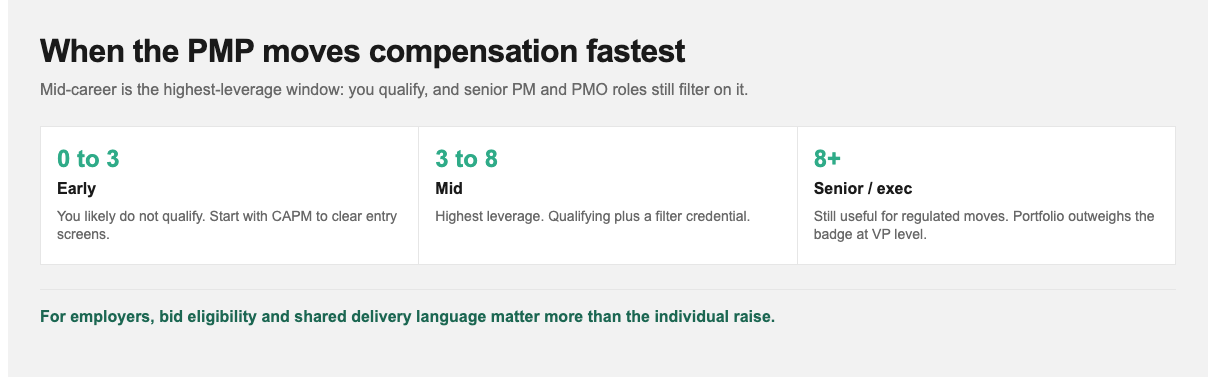
Mid-career (about 3 to 8 years) is the highest-leverage window: you qualify, and senior PM and PMO roles still filter on the credential.
| Career stage | What the PMP does |
|---|---|
| Early (0 to 3 years) | You likely do not qualify yet. Start with the CAPM. It clears entry-level screens. |
| Mid (3 to 8 years) | Highest leverage point. You qualify, and the PMP unlocks senior PM roles and PMO positions that filter on it. |
| Senior (8 to 15 years) | Still valuable, especially for moving into program management or a regulated industry. |
| Executive (15+) | Marginal for compensation. Useful mainly for credibility with clients and boards. |
If you are in the mid-career band and qualify, this is the moment the certification pays back fastest.
CAPM still has salary value. It is smaller than the PMP premium, but it clears screens and shows commitment. That matters for career changers and anyone who cannot yet document 36 or 60 months of leadership. See CAPM certification in 2026 and CAPM vs PMP.
Regional Variation
Project management salaries in the US track the general pattern of technology and professional compensation: highest in major metros (the Northeast corridor, California, Seattle), strong in Texas and the DC area (where federal contracting concentrates PMP demand specifically), and lower in rural and smaller-metro markets.
Remote work has compressed but not eliminated these differences. The DC region is the notable outlier: federal contract requirements create elevated PMP-specific demand rather than just higher general salaries.
The Payback Math
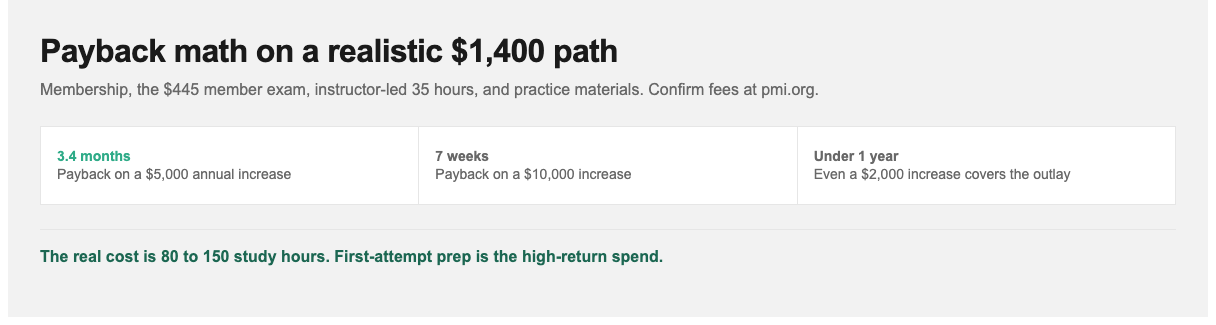
At a realistic all-in cost near $1,400, a $5,000 raise returns the investment in about 3.4 months. Study time is the larger cost.
This is the calculation that actually answers “is it worth it.”
A realistic self-funded PMP costs about $1,400 all-in: PMI membership, the $445 member exam fee as of August 2026, instructor-led training covering the required 35 contact hours, and practice materials. Non-members pay $675 for the exam, which is why joining PMI first is part of the payback story. Full line items are in the PMP certification cost breakdown.
Against that:
- A $5,000 annual salary increase pays the certification back in about 3.4 months.
- A $10,000 increase pays it back in about 7 weeks.
- Even a $2,000 increase pays it back inside the first year.
The certification lasts three years per renewal cycle, with renewal costing $60 for members. There are very few professional investments with this shape: modest fixed cost, multi-year duration, and a plausible return measured in weeks.
The real risk is not the money. It is the 80 to 150 hours of study time. That is why choosing training that gets you through on the first attempt matters more than saving $300 on a cheaper course. A retake costs cash and, more importantly, months of momentum. Use a 12-week PMP study plan so those hours are scheduled, not hoped for.
What It’s Worth to an Employer
If you are funding certifications, the individual salary premium is the wrong metric. It is a cost to you, not a benefit. The employer case rests on three things:
Bid and contract eligibility. If you compete for government, defense, or enterprise work, certified staff are sometimes a stated requirement and often a scored evaluation criterion. One won contract dwarfs the entire training budget.
Delivery consistency. The value of a shared framework is not that the PMBOK Guide is uniquely correct. It is that everyone estimates, escalates, and reports the same way. Cross-team consistency is what makes a portfolio view possible at all.
Retention. Funded certification is among the more effective retention levers available for mid-career technical staff, and it is cheap compared to replacing a project manager mid-delivery.
The counterpoint: certification alone does not fix delivery problems. If projects fail because of unclear priorities or under-resourcing, training will not help. It works when it standardizes practice in an organization that is already functioning.
For how PMP sits next to other credentials on a team roadmap, see the IT certification roadmap for 2026.
PMP Official Exam Prep at StormWind Studios
The return on certification depends almost entirely on passing the first time. StormWind Studios is a PMI Authorized Training Partner. PMP Official Exam Prep uses PMI official content, aligned to the PMBOK Guide 8th Edition, and delivers the 35 contact hours (the PMI training certificate requires live attendance).
Ashley Hunt teaches 8 live days, plus mastery, a PMP application tutorial, an 11th Hour Review, and the Agile Practice Guide. The current exam is situational across People, Process, and Business Environment. Questions ask what you would do, not which process group to recite. Working through that reasoning with an instructor and peers is how first-attempt pass rates stay tied to the salary math above.
For teams, live cohorts also produce a shared vocabulary across your project managers, which is where the organizational return actually comes from. Accidental PMs who still need predictive fundamentals can start with Ashley Hunt’s 7-hour waterfall / predictive PM course before the PMP block.
Next Steps
Check ten job postings for the role you want. If the PMP appears in most of them, the premium is real in your market and the payback math above applies to you. Confirm you meet the requirements, then choose training that satisfies the 35 hours and prepares you to pass on the first attempt.
StormWind Studios offers live, instructor-led PMP Official Exam Prep for individuals and teams. Contact [email protected] for enrollment or team pricing.
Frequently Asked Questions
How much more do PMP holders earn?
PMI’s salary research reports a premium of roughly 30% or more for certified project managers versus non-certified peers in the US. The premium is largest in government contracting, enterprise PMOs, and consulting.
How quickly does the PMP pay for itself?
At a realistic all-in cost near $1,400, a $5,000 raise returns the investment in about three and a half months. Even a modest $2,000 increase pays it back within the first year.
Is the PMP worth it if I work in agile?
It depends on your organization. The current PMP covers agile and hybrid delivery, so it is no longer waterfall-only. In pure product organizations, agile-specific credentials or a delivery track record may still carry more weight.
Does the PMP help if I want to change industries?
Yes. This is one of its strongest uses. It is an industry-agnostic credential that signals transferable capability, which is exactly what is hardest to demonstrate when changing sectors.
Will the PMP get me a promotion?
It removes a barrier rather than creating an opportunity. Where the PMP is a banding or screening criterion, not having it can cap you regardless of performance.
Is CAPM worth anything salary-wise?
Less than the PMP, but it clears entry-level screens and demonstrates commitment. That is valuable for career changers and those who do not yet qualify for the PMP.