PMP Certification Cost in 2026: Every Fee, Broken Down
• Nathaniel Miller
PMI raised PMP exam fees on August 6, 2026. Members now pay $445. Non-members pay $675. Search for PMP certification cost and you usually get that one number. It is real, and it is incomplete.
Membership, the required 35 contact hours of project management education, study materials, and the three-year renewal cycle typically push the true total to three to five times the exam fee. This guide walks through every line item so you can budget once, whether you are paying yourself or funding a team through L&D.
If you are still deciding whether you qualify, start with PMP requirements in 2026. If the question is payback, not price, see PMP salary in 2026.
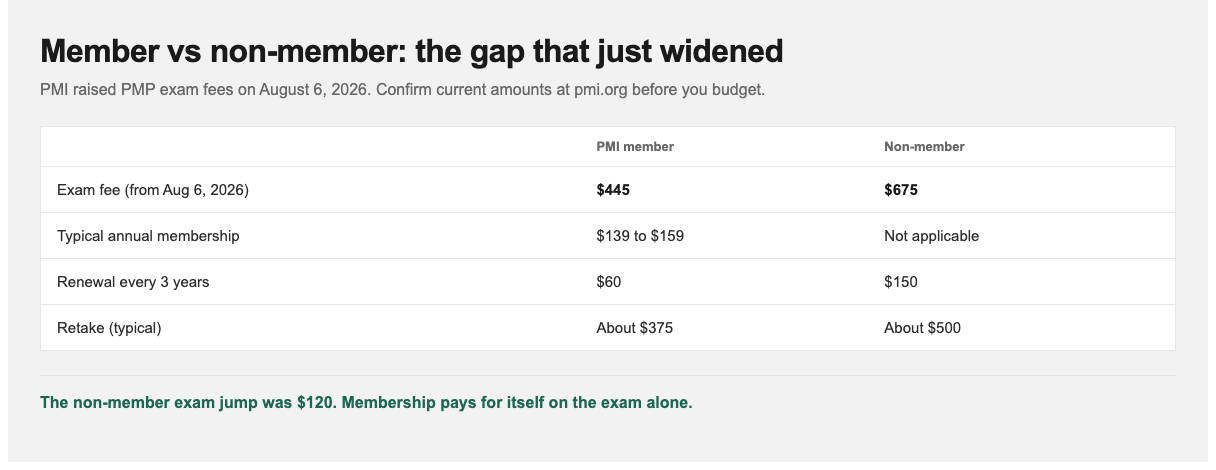
From August 6, 2026, the PMP exam is $445 for PMI members and $675 for non-members. Confirm current fees at pmi.org.
PMP Cost at a Glance
| Cost component | PMI member | Non-member |
|---|---|---|
| PMI membership (annual) | $139 to $159 | n/a |
| PMP exam fee (from Aug 6, 2026) | $445 | $675 |
| 35 contact hours of PM education | $300 to $1,500 | $300 to $1,500 |
| Study materials and practice exams | $0 to $400 | $0 to $400 |
| Retake (per attempt, if needed) | ~$375 | ~$500 |
| Renewal every 3 years (60 PDUs) | $60 | $150 |
| Realistic all-in, first attempt | $900 to $2,100 | $1,000 to $2,600 |
Verify current fees at pmi.org before you budget. PMI changed pricing in August 2026, and many published guides still quote the old $405 / $555 figures. Retake prices in particular move with the exam fee, so treat the retake row as a planning range and confirm before you register.
The Exam Fee, and Why It Just Went Up
On August 6, 2026, PMI increased the PMP exam fee from $405 to $445 for members, and from $555 to $675 for non-members. The non-member jump is the one that changes the math: $120 more, and a $230 gap versus the member price.
That gap is why membership is not a “nice to have” if you are sitting the exam this year. It is the first line item to decide, before you pick a course or a test date.
PMI Membership: The Math That Makes It Obvious
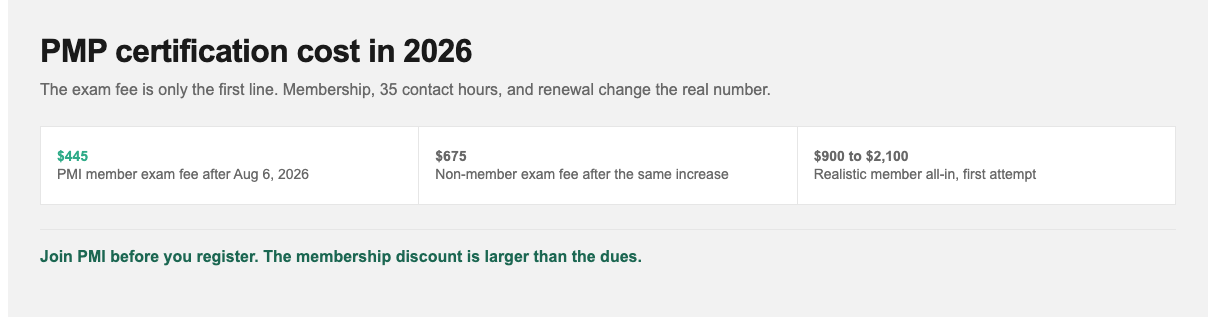
Join PMI before you register. Membership at $139 to $159 cuts the exam fee by $230 and lowers every renewal after that.
PMI membership runs $139 to $159 per year. It reduces your exam fee by $230. Even in the narrowest reading, joining PMI before you register saves you roughly $70 on the exam alone. Membership also includes digital access to the PMBOK Guide and PMI’s standards library, which you would otherwise buy.
Add the renewal math and it stops being close. Renewal costs $60 for members versus $150 for non-members. If you plan to hold the PMP for more than one cycle, membership is the cheaper path in every scenario we ran.
The practical rule: join PMI first, then register for the exam. Doing it in the other order is one of the most common (and most expensive) sequencing mistakes candidates make.
For L&D teams, that rule is a procurement detail, not a preference. Skipping membership to “simplify the PO” costs $230 on day one and $90 every renewal cycle after that.
The 35 Contact Hours: The Cost Nobody Budgets For
Before you can sit the PMP, you must document 35 contact hours of formal project management education. This is not optional and it is not waivable. It is also the largest variable in your total cost, ranging from about $300 for a self-paced course to $2,000 for an in-person bootcamp.
What counts:
- Courses from PMI Authorized Training Partners
- University or college project management coursework
- Instructor-led training, live online or in person
- Employer-provided PM training, if the hours are documented
- Self-paced courses that specify contact hours
What does not count: on-the-job experience, independent reading of the PMBOK Guide, general business or leadership courses, and any training that does not document a specific number of hours.
Because this requirement is mandatory anyway, choose training that does two jobs: it satisfies the 35 hours, and it prepares you for a situational exam. The cheapest box-check plus a retake is usually more expensive than one live course that covers both. StormWind’s path is PMP Official Exam Prep: PMI ATP content, 35 contact hours, live instruction required for the PMI training certificate.
If you do not yet meet the experience requirement, the cheaper sibling is CAPM (23 contact hours, no experience). See CAPM vs PMP before you spend the 35-hour budget on the wrong exam.
Retake Fees and How to Think About Them
A retake costs roughly $375 for members and $500 for non-members. Confirm the current figure at pmi.org when you schedule. You get three attempts in a one-year eligibility period. After that you wait a year before reapplying.
Budget for the possibility. The PMP has a meaningful failure rate, and a retake costs more than most practice-exam packages. Spending $100 to $200 on a quality exam simulator to avoid a $375 to $500 retake is one of the highest-return decisions available to you. A structured 12-week PMP study plan is the other half of that bet.
Renewal: The Cost That Never Stops
The PMP is valid for three years. To keep it, you need 60 PDUs (professional development units) per cycle plus a renewal fee of $60 for members or $150 for non-members.
Many PDUs are free. PMI webinars, chapter events, and certain work activities count. It is still an ongoing commitment, and it is the part candidates most often forget when comparing the PMP to a one-and-done credential.
Three Realistic Scenarios
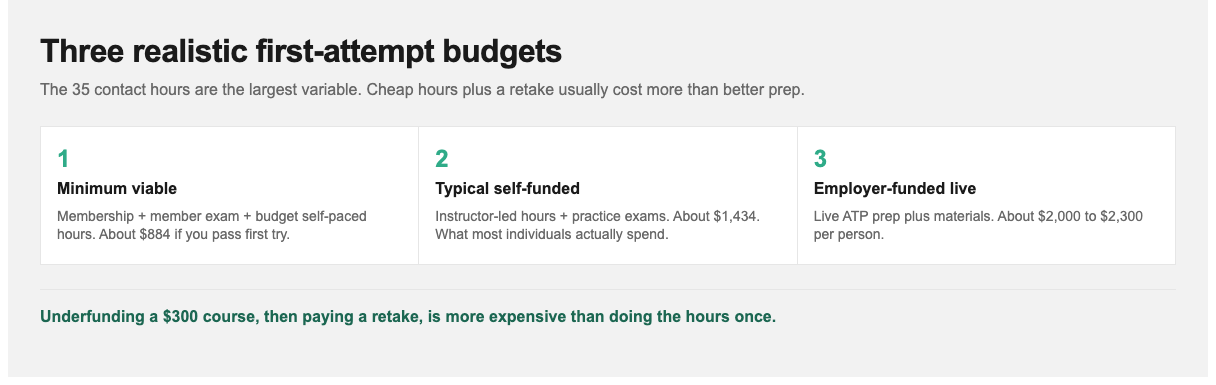
Most individual candidates land near $1,400. Employer-funded live training usually lands between $2,000 and $2,300 per person.
Scenario 1: Self-funded, minimum viable
PMI membership ($139) + member exam ($445) + budget self-paced 35-hour course ($300) + free study materials = about $884, assuming a first-attempt pass.
Scenario 2: Self-funded, realistic
Membership ($139) + member exam ($445) + instructor-led training ($700) + practice exams ($150) = about $1,434. This is what most individual candidates actually spend.
Scenario 3: Employer-funded, instructor-led
Membership ($139) + member exam ($445) + live instructor-led training ($1,200 to $1,500) + materials ($200) = about $2,000 to $2,300 per person. Higher upfront, and typically a better first-attempt pass rate because the hours are structured and the exam format is practiced in class.
What Employers Should Budget Per Person
If you are funding certifications for a project management team, budget $1,800 to $2,500 per person for an instructor-led path, and expect volume pricing to improve that. Two things are worth knowing before you lock the number:
- Underfunding costs more. A $300 course plus a $375 retake plus a second attempt costs more than good training did in the first place, and it burns a quarter of delivery time while that person is studying twice.
- Pay for membership. It is $139 that saves $230 immediately and $90 per renewal cycle afterward. Skipping it to simplify procurement is a false economy.
For where PMP sits next to other credentials, see the IT certification roadmap for 2026.
PMP Official Exam Prep at StormWind Studios
StormWind Studios is a PMI Authorized Training Partner (ATP). The live PMP Official Exam Prep course uses PMI official content, is aligned to the PMBOK Guide 8th Edition, and delivers the 35 contact hours you need to apply.
Two details matter for budget and eligibility:
- The PMI training certificate requires live attendance. This is instructor-led on purpose, not a video library you can click through after hours.
- Ashley Hunt teaches the program across 8 live days, plus mastery work, a PMP application tutorial, an 11th Hour Review, and the Agile Practice Guide. The exam is built around People, Process, and Business Environment, with predictive, agile, and hybrid scenarios mixed together.
That package is meant to replace two purchases: a cheap 35-hour certificate and a separate exam-prep product. For teams, live delivery also means your project managers can bring your actual environment into the room instead of working through generic case studies.
If someone on the team is an accidental project manager who needs predictive fundamentals before PMP, start with the 7-hour waterfall / predictive PM course, also taught by Ashley Hunt.
Next Steps
If the PMP is on your roadmap, the sequence that costs least is: join PMI, complete your 35 contact hours with training that also prepares you for the exam, then register while the material is fresh. Confirm current fees at pmi.org before you commit. They moved in August 2026 and may move again.
StormWind Studios offers live, instructor-led PMP Official Exam Prep for individuals and teams. For enrollment or team pricing, contact [email protected].
Frequently Asked Questions
How much does the PMP certification cost in total?
Realistically $900 to $2,600 for a first attempt, depending on membership status and training choice. The exam fee alone is $445 for PMI members and $675 for non-members as of August 6, 2026.
Is PMI membership worth it just for the exam discount?
Yes. Membership costs $139 to $159 and reduces the exam fee by $230, so it pays for itself immediately, before counting cheaper renewals and included PMBOK Guide access.
Why did the PMP exam fee increase?
PMI implemented a global fee increase effective August 6, 2026, raising the member fee from $405 to $445 and the non-member fee from $555 to $675. Many online guides still quote the older figures.
What’s the cheapest way to get the 35 contact hours?
Self-paced online courses start around $300. Since the hours are mandatory regardless, choosing training that also prepares you to pass is usually cheaper overall than paying separately for a cheap box-check and then a retake.
Does the PMP cost anything after I pass?
Yes. It renews every three years, requiring 60 PDUs plus a $60 renewal fee for members or $150 for non-members.
Can my employer pay for it?
Very often, yes. Many organizations have a training budget or tuition-reimbursement program that covers certification. Framing the request around delivery outcomes (fewer failed projects, bid eligibility, a shared process) tends to work better than framing it as personal development.