Cisco Certification Path 2026: CCNA, CCNP, CCIE & Costs
• Nathaniel Miller
The Cisco certification path has three main levels: CCNA (associate, one $300 exam), CCNP (professional, a $400 core exam plus a $300 concentration exam) and CCIE (expert, the same $400 core exam plus a $1,600 eight-hour lab). Every level is valid for three years. No level is a formal prerequisite for the next, but almost everyone climbs them in order.
The part most guides skip is how the exams overlap. The CCNP core exam also counts as the CCIE qualifying exam, so one $400 exam moves you forward on two credentials at once. Below is the full path, what each step costs, and which track to pick.
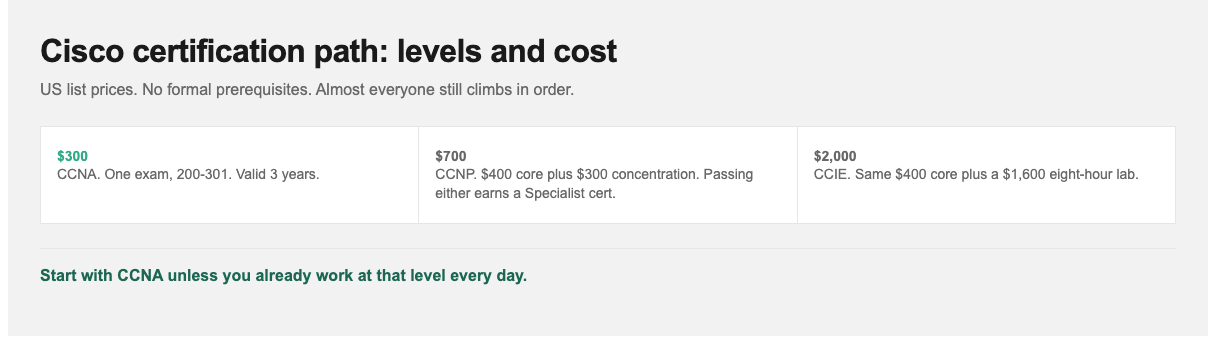
One $400 core exam counts for both CCNP and the CCIE qualifier, so the full path is $2,600 in exam fees.
The Cisco Certification Levels at a Glance
| Level | Certification | Exams required | Exam fees | Typical experience |
|---|---|---|---|---|
| Entry | CCST (Networking, Cybersecurity, IT Support) | 1 | About $125 | None. Aimed at students and career changers |
| Associate | CCNA | 1 (200-301) | $300 | Some IT exposure; about a year of networking helps |
| Professional | CCNP | 2 (core + concentration) | $700 ($400 + $300) | 3 to 5 years in networking |
| Expert | CCIE | 2 (core + 8-hour lab) | $2,000 ($400 + $1,600) | 5 to 7+ years, senior engineering role |
| Architect | CCAr | Board review | By application | 10+ years designing large networks |
Fees are Cisco’s US list prices as of 2026. The CCIE lab is $1,900 if you take it at a mobile lab on Cisco-supplied equipment. Cisco changes fees by region and over time, so check the official exam page before you book.
Step 1: CCNA, the Foundation
The CCNA (200-301) is the single most recognized networking certification. It is one 120-minute exam covering network fundamentals, network access, IP connectivity, IP services, security fundamentals, and automation and programmability. It costs $300, and each retake costs the full fee again.
CCNA is broad rather than deep. It shows an employer you can configure switches and routers, subnet without a calculator, and troubleshoot a routing problem. For most people it is the right first Cisco exam even though Cisco does not require it.
We have covered this level in detail already: see CCNA certification cost and salary in 2026 for the full budget, and how to study for the CCNA for a week-by-week plan.
Cisco also offers associate-level certifications in cybersecurity and automation alongside the core CCNA. If your work is in a security operations center, look at the cybersecurity associate track before CCNP Security.
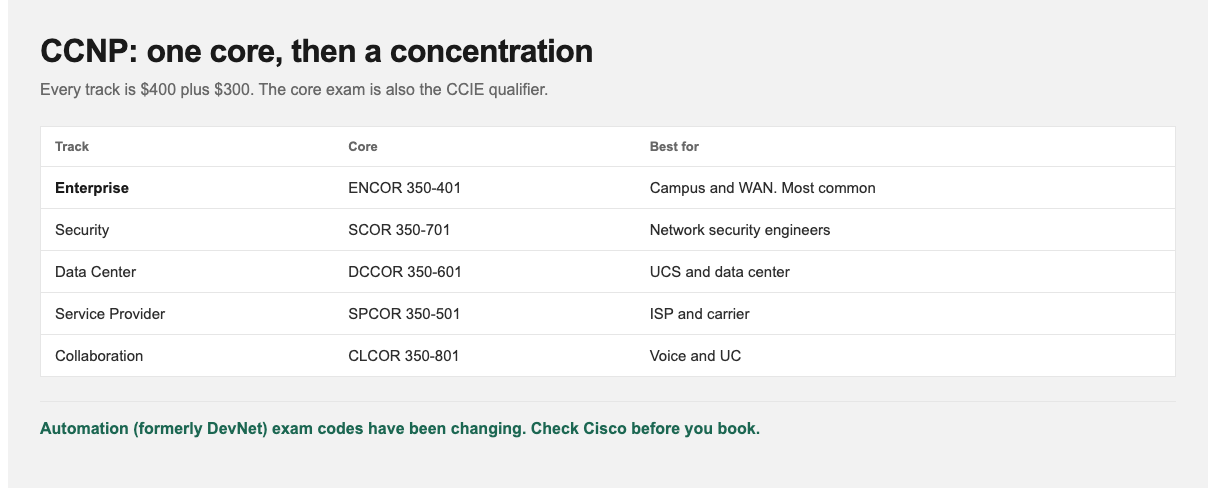
Pick the CCNP track that matches next year’s job. Enterprise is the default if you are unsure.
Step 2: CCNP, Choose a Track
CCNP is where you specialize. Every CCNP track uses the same structure: one core exam ($400) plus one concentration exam of your choice ($300). You can take them in any order, and passing either one on its own earns a Cisco Certified Specialist credential, so progress is never wasted.
| CCNP track | Core exam | Example concentrations | Best for |
|---|---|---|---|
| Enterprise | ENCOR 350-401 | ENARSI (advanced routing), ENSLD (design), ENWLSI (wireless) | Campus and WAN engineers. The most common choice |
| Security | SCOR 350-701 | SISE (Identity Services Engine), SVPN (VPNs), firewall | Network security engineers |
| Data Center | DCCOR 350-601 | Design, ACI, storage networking | Data center and UCS engineers |
| Service Provider | SPCOR 350-501 | Advanced routing, VPN services | ISP and carrier engineers |
| Collaboration | CLCOR 350-801 | Call control, contact center, cloud collaboration | Voice and unified communications engineers |
Cisco has also renamed and reorganized its automation (formerly DevNet) certifications across associate, professional and expert levels. If automation is your focus, check Cisco’s current track list, since the exam codes have been changing.
Which track? Choose the one that matches the job you have or want next year, not the one that sounds most impressive. If you are unsure, take Enterprise. ENCOR covers the widest range of real-world topics, and it is also the qualifying exam for CCIE Enterprise Infrastructure and CCIE Enterprise Wireless.
Step 3: CCIE, the Expert Lab
CCIE is a different kind of exam. The qualifying exam is the same core exam you took for CCNP, so many candidates already have it. The second step is an eight-hour hands-on lab in which you design, deploy, operate and optimize a network under time pressure.
- Cost: $400 core + $1,600 lab per attempt, plus travel to a lab location for most candidates.
- Pass rate: Cisco does not publish one. Training providers commonly report roughly a quarter to a third of candidates passing on the first attempt, so budget for a possible retake.
- Prep time: Most candidates spend 6 to 12 months with structured lab practice. Several hundred hours of hands-on time is normal.
CCIE is worth it for senior engineers whose job is already expert level, such as people who lead designs, run migrations or are the final escalation point. It rarely makes sense as a way to get that job without the experience behind it.
What the Full Path Costs
| Path | Exam fees only | Realistic total with training and labs |
|---|---|---|
| CCNA | $300 | $500 to $3,000 |
| CCNA → CCNP | $1,000 | $2,000 to $7,000 |
| CCNA → CCNP → CCIE (shared core) | $2,600 | $8,000 to $20,000+ |
The shared core exam is why the full path costs $2,600 in exam fees rather than $3,000. You take ENCOR (or your track’s core) once, and it counts for both CCNP and as the CCIE qualifier.
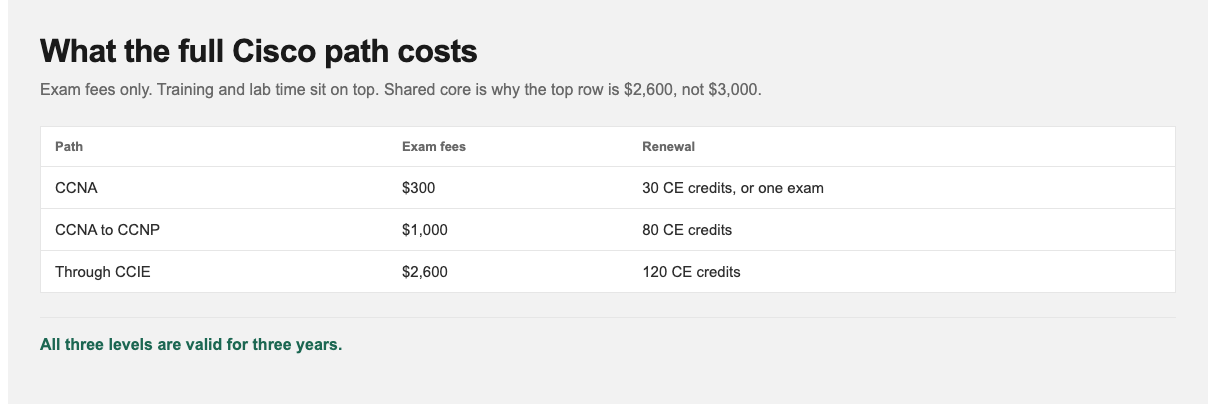
A higher certification renews the ones below it. Passing CCNP renews CCNA.
Renewal: Three Years, Two Routes
Every Cisco certification is valid for three years. You can recertify by passing exams, by earning Continuing Education (CE) credits, or by combining the two:
- CCNA: 30 CE credits, or pass one qualifying exam
- CCNP: 80 CE credits, or pass a core exam or two concentration exams
- CCIE: 120 CE credits, or pass the lab again, or a combination
Earning a higher-level certification renews the lower ones beneath it, so passing CCNP also renews your CCNA.
How StormWind Studios Approaches the Cisco Path
Cisco exams reward hands-on time far more than reading. StormWind’s live, instructor-led courses are built around that. Start with CCNA 200-301: Implementing and Administering Cisco Solutions, then move to CCNP Enterprise ENCOR v1.2 for the core exam. For the concentration, ENSLD covers enterprise design, and the CCNP Security SISE and Service Provider SPCOR courses serve those tracks.
If your path runs through security, read our explainer on Cisco Firepower, which shows up throughout the CCNP Security material.
Next Steps
Most people should start with CCNA, then take the core exam for the CCNP track that matches their job, then add the concentration. Decide on CCIE only once your day-to-day work is already expert level. For a view across vendors, see our IT certification roadmap for 2026.
Frequently Asked Questions
What is the correct order of Cisco certifications?
CCNA (associate), then CCNP (professional), then CCIE (expert). There is an entry-level CCST below CCNA and the CCAr architect credential above CCIE. Cisco has no formal prerequisites, but the levels build on each other.
How much do Cisco certifications cost?
CCNA is $300. CCNP is $700 ($400 core + $300 concentration). CCIE is $2,000 ($400 core + $1,600 lab). Because the CCNP core doubles as the CCIE qualifier, the full path costs $2,600 in exam fees.
Do I need CCNA before CCNP?
No. Cisco removed formal prerequisites, but CCNP exams assume CCNA-level knowledge, so skipping it is rarely a good idea.
How long are Cisco certifications valid?
Three years. Recertify by retaking exams, earning CE credits (30 for CCNA, 80 for CCNP, 120 for CCIE) or a mix of both.
Which CCNP track is best?
Enterprise is the most popular and the most transferable. Choose Security, Data Center, Service Provider or Collaboration only if your role is already in that area.
Is CCIE worth it?
For senior engineers already doing expert-level work, usually yes. CCIE holders are rare and well paid. Without that experience, CCNP is the better investment.