How Long to Study for the PMP: A Realistic 12-Week Plan
• Nathaniel Miller
A realistic PMP study plan for most candidates is 100 to 150 hours, or about 12 weeks at 10 to 12 hours a week around a full-time job. Experienced project managers with formal methodology behind them can come in lower. People who have led work without a shared vocabulary should plan higher.
The PMP is not a memorization exam anymore. It presents scenarios and asks what you would do next, drawing on predictive, agile, and hybrid approaches. That changes how you should study. Reading the PMBOK Guide cover to cover is one of the least efficient preparation strategies available, and it is still the most common one.
This is a week-by-week plan built around the exam’s three domains and its situational question format. Confirm you meet PMP requirements before you book, and budget using PMP certification cost in 2026. If the credential’s payback is still an open question, see PMP salary in 2026.
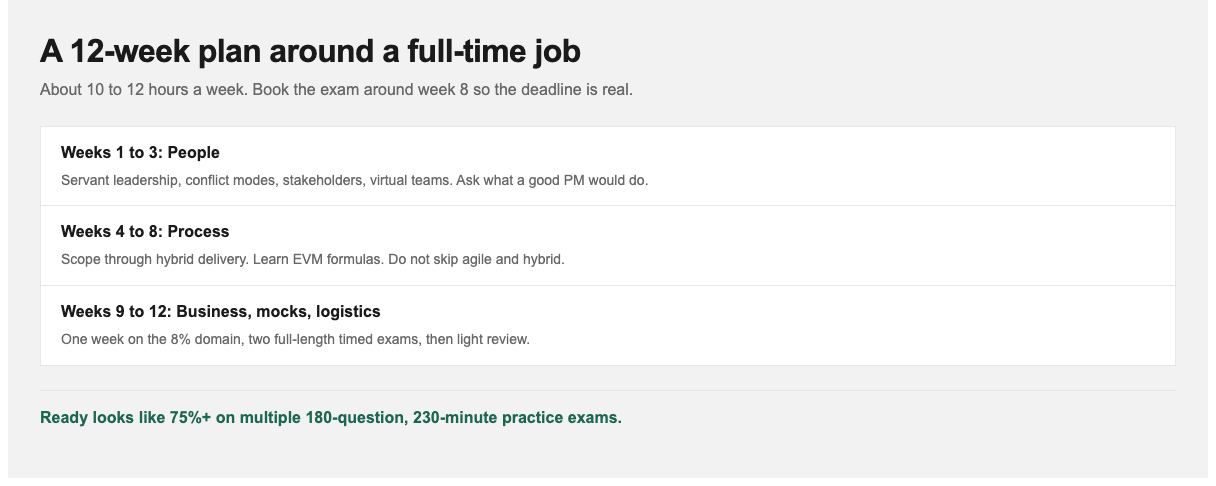
Most candidates need 100 to 150 hours. Treat 12 weeks at 10 to 12 hours a week as the default, then compress or extend based on methodology background.
How Long It Really Takes
| Your starting point | Study hours needed | At 10 hrs/week |
|---|---|---|
| Experienced PM, formal methodology background | 80 to 100 | 8 to 10 weeks |
| Experienced PM, informal or agile-only background | 100 to 150 | 10 to 15 weeks |
| Qualifying experience but little formal PM exposure | 150 to 200 | 15 to 20 weeks |
The plan below assumes the middle case: 12 weeks at 10 to 12 hours per week. Compress it if you have formal methodology grounding. Extend it if terminology is new to you.
If you do not yet qualify for PMP, do not force this calendar. CAPM is the 23-hour path with no experience requirement. Compare options in CAPM vs PMP.
What’s Actually on the Exam
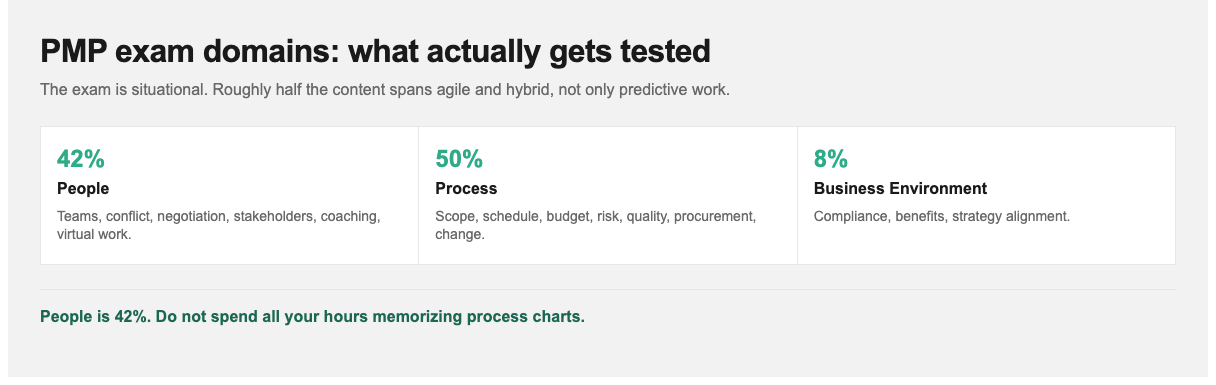
Process is half the exam, but People is 42%. Roughly half the content spans agile and hybrid, which is where predictive-only PMs lose marks.
| Domain | Weight | What it covers |
|---|---|---|
| People | 42% | Leading teams, conflict, negotiation, stakeholder engagement, coaching, virtual teams |
| Process | 50% | Delivery mechanics: scope, schedule, budget, risk, quality, procurement, change |
| Business Environment | 8% | Compliance, benefits realization, organizational strategy alignment |
Two facts candidates consistently underestimate. First, People is 42%. Nearly half the exam is leadership and interpersonal judgment, not technical process. Second, roughly half the exam spans agile and hybrid delivery. If you have only ever worked in one delivery style, that gap is your highest-priority study target.
StormWind’s PMP Official Exam Prep is built on those three domains, PMI official (ATP) content, and the PMBOK Guide 8th Edition, with the Agile Practice Guide included because that hybrid half is not optional.
A 12-Week PMP Study Plan at 10 to 12 Hours a Week
Weeks 1 to 3: The People Domain
Start here, not with process. It is the largest single behavioral chunk and the one where experience helps most, which builds early confidence.
- Week 1: Team building and development, servant leadership, emotional intelligence, motivation. How a servant leader responds differently than a directive manager. The exam tests this distinction repeatedly.
- Week 2: Conflict resolution (know the modes and when each is appropriate), negotiation, stakeholder identification and engagement strategies.
- Week 3: Virtual and distributed teams, coaching and mentoring, removing impediments, training needs. Take a domain-specific practice set at week’s end.
Study approach: for every concept, ask “what would a good project manager do here?” That is the form PMP exam questions take.
Weeks 4 to 8: The Process Domain
The biggest block at 50%. Five weeks, organized by knowledge area rather than process group. The exam does not ask you to recite process groups.
- Week 4: Integration and scope. Charter, requirements gathering, WBS, scope creep versus approved change. Predictive scope control versus backlog management.
- Week 5: Schedule and cost. Critical path, dependencies, estimating techniques, earned value management. Learn EVM formulas properly: CPI, SPI, EAC, VAC. It is the one genuinely calculation-heavy area, and it is learnable.
- Week 6: Risk and quality. Identification, qualitative versus quantitative analysis, response strategies, risk register mechanics. Quality planning versus assurance versus control.
- Week 7: Procurement, communications, resources. Contract types (know when fixed-price versus cost-reimbursable is appropriate), communication planning, resource allocation.
- Week 8: Hybrid and agile delivery. Iterative approaches, incremental delivery, choosing a delivery approach, tailoring. Do not skip this week. It is where predictive-background candidates lose the most marks.
If your day job is mostly predictive (fixed scope, sign-off gates), pair week 8 with a pass through StormWind’s 7-hour waterfall / predictive PM course only if you still need the fundamentals. It does not replace PMP contact hours. It clarifies the predictive side so the hybrid questions make more sense.
Week 9: Business Environment
Only 8% of the exam, so one focused week is proportionate. Cover compliance requirements, benefits realization and how it differs from project success, organizational change management, and strategy alignment.
Do not over-invest here, and do not skip it. These questions are usually straightforward if you have read the material once.
Weeks 10 to 11: Practice Exams
This is the highest-value phase and the one most often shortchanged.
Take full-length, timed practice exams: 180 questions, 230 minutes, no interruptions. Simulating the endurance requirement matters as much as the content. Fatigue in the final hour is a real failure mode.
How to read your scores:
- Below 60%: content gaps remain. Return to the weak domain before testing again.
- 65% to 70%: borderline. Keep working. Do not book yet.
- 75%+ consistently across multiple full exams: you are ready.
Review every wrong answer until you understand why the correct answer is better, not just what it was. PMP exam questions frequently offer two defensible options where one is more correct. Learning to spot that distinction is the actual skill being tested.
Week 12: Review and Logistics
Light review only. No new material. Revisit your weakest domain, re-run EVM formulas, and skim your notes.
Handle the logistics: confirm your test center or complete the OnVUE system check for online proctoring, verify your ID matches your registration exactly, and plan the day. The exam includes two scheduled breaks. Know when you will take them.
Answering Situational Questions
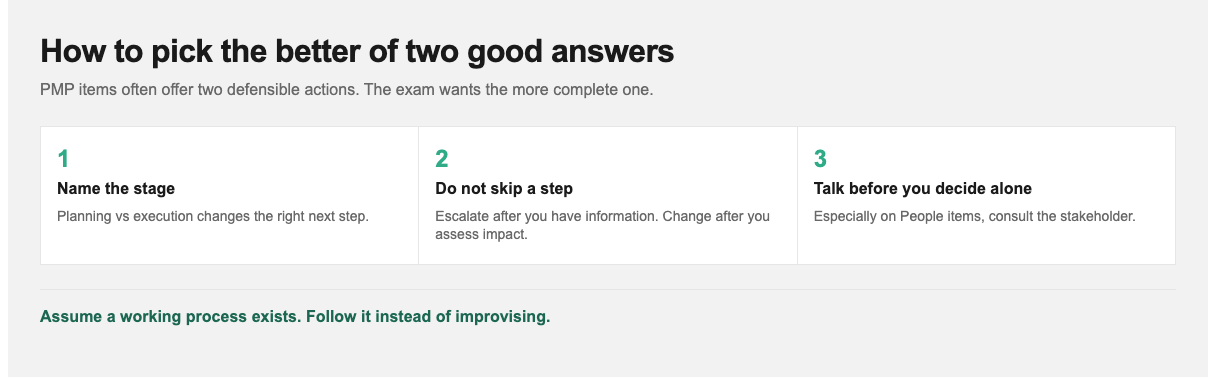
Name the project stage, do not skip a step, and prefer communication over deciding alone.
A technique worth internalizing, because it decides borderline passes.
When a scenario offers four plausible actions:
- Identify what stage the scenario is in. The right action differs depending on whether you are planning or mid-execution.
- Eliminate anything that skips a step. Escalating before gathering information, or changing scope before assessing impact, is nearly always wrong.
- Prefer proactive over reactive. The exam’s model project manager anticipates rather than firefights.
- Prefer communication over unilateral action. Especially in People-domain questions, consulting the stakeholder usually beats deciding alone.
- Assume you have a functioning process. If a documented approach exists, follow it rather than improvising.
Studying Around a Full-Time Job
Ten to twelve hours a week is real work on top of a job. What works:
- Two weekday sessions of 90 minutes plus one longer weekend block beats daily fragments.
- Protect the weekend block for practice exams. Full-length attempts need uninterrupted time.
- Use your own projects as a study aid. Mapping exam concepts to work you are actually doing is the most efficient retention technique available to you.
- Book the exam before you feel ready. An open-ended timeline is the most common reason candidates never sit it. Schedule it at week 8.
L&D teams can make this easier by running a live cohort so the 35 contact hours and the calendar are the same object, not two competing nights on the calendar. See the IT certification roadmap for 2026 if PMP is one stop on a longer team path.
PMP Official Exam Prep at StormWind Studios
StormWind Studios is a PMI Authorized Training Partner. PMP Official Exam Prep uses PMI official content and delivers the 35 contact hours. The PMI training certificate requires live attendance, which is why this is not a watch-on-your-own library.
Ashley Hunt teaches 8 live days, plus mastery, a PMP application tutorial, an 11th Hour Review, and the Agile Practice Guide, aligned to the PMBOK Guide 8th Edition and the People / Process / Business Environment exam.
Structure is why cohort-based training outperforms self-study for most candidates. Not because the material is unavailable elsewhere, but because a scheduled cohort with a live instructor eliminates the two things that derail self-directed candidates: drift, and unresolved confusion. Situational PMP exam questions in particular are best learned by arguing them through with someone who can explain why the second-best answer is second-best.
For teams, running a cohort together also means your project managers finish with a shared approach rather than twelve individual interpretations. Drop the 8 live days into weeks 1 to 8 of this plan, then use weeks 10 to 11 for full-length simulators and week 12 for the 11th Hour Review.
Next Steps
Pick your start date, block the study time in your calendar before you begin, and book the exam for roughly week 12 so the deadline is real. Then work the plan in order: People first, Process next, agile and hybrid explicitly.
StormWind Studios offers live, instructor-led PMP Official Exam Prep for individuals and teams. Contact [email protected] for upcoming cohort dates.
Frequently Asked Questions
How many hours do I need to study for the PMP?
Most candidates need 100 to 150 hours. Experienced project managers with formal methodology backgrounds can pass with 80 to 100. Those with informal backgrounds should plan for 150 to 200.
Can I pass the PMP in 30 days?
It is possible with full-time study and strong existing knowledge, but it is not advisable for most candidates. The situational format rewards developed judgment, which is hard to compress.
Do I need to read the whole PMBOK Guide?
No, and reading it cover to cover is an inefficient strategy. Use it as a reference alongside structured training and practice exams rather than as your primary study path.
What do PMP exam questions look like?
Most PMP exam questions are situational. You get a scenario and four plausible actions, then pick what a project manager should do next. Two answers often look defensible. The skill is choosing the more correct one, which is why timed practice exams matter more than rereading a chapter.
What practice exam score means I’m ready?
Consistently 75% or above across multiple full-length, timed practice exams. A single good score is not sufficient evidence.
How much of the PMP exam is agile?
Roughly half of the exam content spans agile and hybrid approaches. Candidates from purely predictive backgrounds should treat this as their priority study area.
Should I book the exam before I start studying?
Book it around week 8 of a 12-week plan. Early enough to create a real deadline, late enough that you can judge your readiness from practice scores.