Agile vs Waterfall: How to Actually Choose (Decision Table)
• Nathaniel Miller
Waterfall suits projects where the requirements are fixed and the cost of change is high. Agile suits projects where the requirements will move and the cost of being wrong for six months is higher. Most real delivery organizations run both. The useful skill is knowing which one a given project needs.
Plenty of articles will tell you Agile is modern and Waterfall is outdated. That is not how it works in practice. Regulated, safety-critical, and fixed-contract work still runs predictively for good reasons, and PMI certifies both approaches. This guide gives you a decision table you can apply to an actual project this week.
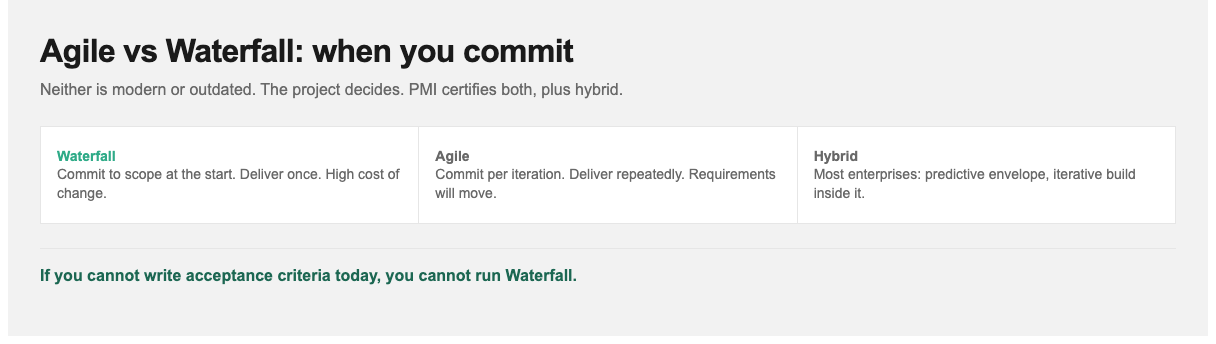
The root difference is when you commit to scope. Most other differences follow from that.
The Decision Table
Score your project against these eight factors. If most of your answers fall in one column, that is your answer. If they split, read the hybrid section below.
| Factor | Choose Waterfall when… | Choose Agile when… |
|---|---|---|
| Requirements | Fully known and documented up front | Partly unknown, or expected to change |
| Cost of change | High: rework means re-engineering | Low: work is small and replaceable |
| Customer availability | Available at kickoff and sign-off only | Available continuously throughout |
| Regulatory burden | Heavy: audit trail and documentation required | Light: no external documentation mandate |
| Contract shape | Fixed scope, fixed price, fixed date | Time and materials, or internal budget |
| Team structure | Specialists working in sequence, possibly across vendors | Cross-functional and co-located or well-connected |
| Dependencies | Physical, sequential, or hardware-bound | Mostly software, independently deployable |
| Definition of success | Delivered on scope, on time, on budget | Delivered value, validated by users |
One shortcut: if you cannot write the acceptance criteria today, you cannot run Waterfall. Predictive planning depends on knowing what “done” means before you start. If you genuinely do not know yet, an iterative approach is not a preference. It is a requirement.
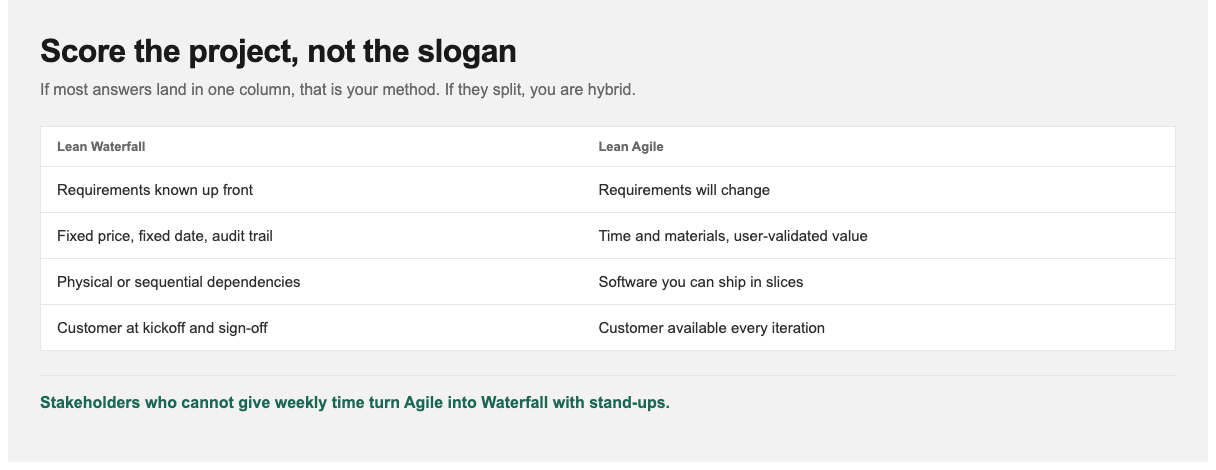
If the answers split across columns, you have a hybrid project. Do not force a single label.
What Waterfall Actually Is
Waterfall, more accurately called predictive project management, runs a project through sequential phases, each completed and signed off before the next begins: requirements, design, build, test, deploy, close.
Its reputation for rigidity is partly deserved and partly a misreading. The sequence is deliberate. It front-loads the thinking so the expensive phases execute against a settled plan. When requirements really are stable, that produces predictable cost and schedule, a clear audit trail, and a contract you can hold a vendor to.
Where it fails is when the plan meets reality and reality wins. A requirement discovered in testing has to be retrofitted through design and build, and by then the budget is largely spent. Our guide to Waterfall project management covers the phases and trade-offs in full.
What Agile Actually Is
Agile is a set of principles, not a methodology. It delivers work in short iterations, gets it in front of users, and uses what you learn to shape what comes next. Scrum, Kanban, and SAFe are frameworks that implement those principles in different ways.
The core bet is that feedback beats forecasting. Rather than plan twelve months and discover in month eleven that the market shifted, you ship something small in two weeks and adjust. That is genuinely powerful when requirements are uncertain.
Where it fails is when it becomes an excuse for the absence of a plan. “We are Agile” is not an answer to “what will this cost and when will it be done.” If you owe a customer a fixed-price delivery on a fixed date, iteration alone does not discharge that obligation. Agile also assumes a level of customer engagement that many organizations promise and few sustain.
Head to Head: The Five Differences That Matter
1. When you commit to scope. Waterfall commits at the start. Agile commits per iteration. This is the root difference. Most others follow from it.
2. When testing happens. Waterfall concentrates testing into a phase near the end. Agile tests continuously. That is why defects found late in a Waterfall project are so expensive: the surrounding work is already built on the flawed assumption.
3. How much documentation exists. Waterfall produces documentation as a deliverable in its own right, which regulated industries require. Agile produces the minimum needed to build the thing, which is faster but leaves less of an audit trail.
4. Who the customer is to the team. In Waterfall the customer approves at gates. In Agile the customer is effectively part of the team. If your stakeholders cannot give you weekly time, Agile will degrade into Waterfall with stand-ups.
5. What “late” means. A late Waterfall project has missed a date. A late Agile project has delivered less scope than hoped, but has delivered something. Which failure mode your organization can tolerate is a real input to the decision.
Hybrid Delivery: What Most Organizations Actually Do
The honest answer for most teams is not one or the other. Common workable patterns:
- Predictive envelope, iterative build. Fix the budget, milestones, and governance up front. Run the build iteratively inside that envelope. This is the most common enterprise pattern. It satisfies finance without pretending you know every requirement.
- Waterfall for infrastructure, Agile for software. Hardware, network, and facilities work is genuinely sequential. The application layer on top of it does not have to be.
- Phase-gated discovery, then sprints. Use a predictive discovery phase to reduce uncertainty enough to make estimates meaningful, then switch to iterations for delivery.
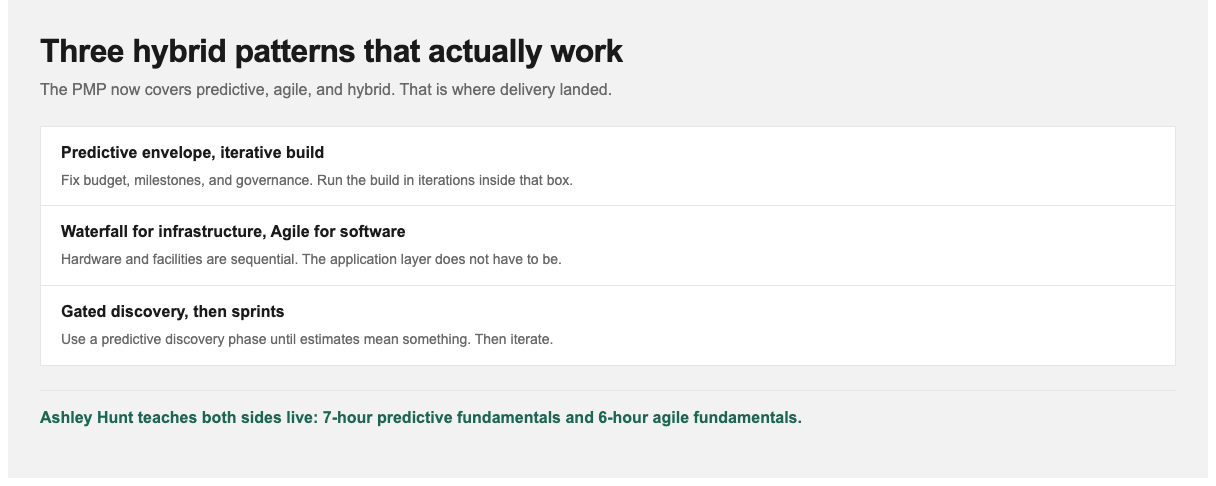
PMI’s PMP now covers predictive, agile, and hybrid. That is where the profession has landed.
PMI’s own certification structure reflects this. The PMP now covers predictive, agile, and hybrid approaches rather than treating them as rival camps.
Which Should You Learn?
If you are building a project management career, learn both, and expect to be asked about hybrid delivery in interviews. The PMP covers all three approaches, making it the broadest credential. Our PMP requirements guide covers whether you qualify, and the PMP cost breakdown covers what it takes to get there.
If you are earlier in your career, the CAPM is the entry point and requires no prior project experience. See CAPM vs PMP for which to start with. If you are choosing a decision-making process for your team rather than a delivery methodology, the nominal group technique is a structured way to get a group to a defensible answer.
Predictive and Agile Training at StormWind Studios
Methodology arguments are easier to settle when your team has actually run both. StormWind teaches predictive and agile delivery as complementary skills rather than competing ideologies.
PM Fundamentals: Waterfall/Predictive Project Management is 7 hours with Ashley Hunt: phase-gated delivery for accidental project managers. PM Fundamentals: Agile Project Management is 6 hours with the same instructor on iterative delivery. Both are live, so your team can ask the “but what about our situation” questions that no framework document answers. For teams heading toward certification, PMP Official Exam Prep covers predictive, agile, and hybrid as the exam now requires.
Next Steps
Take a project you are running now and score it against the decision table above. If the answers split across columns, you have a hybrid project. The useful next question is which parts need a gate and which parts need an iteration.
Browse StormWind’s project management courses to see how your team can build both capabilities. For more information, visit stormwindstudios.com or reach out to [email protected].
Frequently Asked Questions
Is Agile better than Waterfall?
Neither is better in the abstract. Agile suits uncertain, changeable requirements. Waterfall suits fixed requirements with a high cost of change. Regulated and fixed-price work often requires a predictive approach.
What is the main difference between Agile and Waterfall?
When you commit to scope. Waterfall commits up front and delivers once. Agile commits per iteration and delivers repeatedly. Most other differences follow from that.
Can you use Agile and Waterfall together?
Yes, and most enterprises do. The common pattern is a predictive budget and governance envelope with iterative delivery inside it.
Does the PMP cover Agile?
Yes. The PMP covers predictive, agile, and hybrid approaches, which is one reason it remains the broadest project management credential.
Which industries still use Waterfall?
Construction, manufacturing, defense, pharmaceuticals, and any context with heavy regulatory documentation requirements or physical sequential dependencies.
Is Waterfall dead?
No. It is less common in software but remains standard where requirements are stable and an audit trail is mandatory.