Management Skills for New Managers: The First 90 Days
• Nathaniel Miller
The skills that got you promoted are not the skills the job now requires. New managers are measured on what their team delivers, not on what they personally produce, and that shift catches most people out in the first quarter.
This is a practical 90-day framework: what to focus on in each phase, the five skills that matter most early, and the mistakes that are hardest to walk back from. It is written for people who were promoted from inside a technical team, which is how most IT managers arrive in the role.
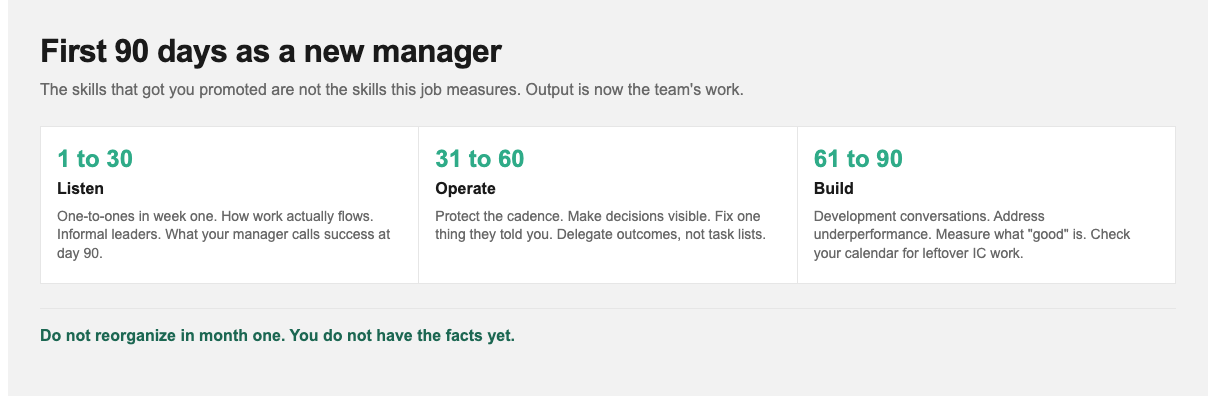
Days 1 to 30 you learn. Days 31 to 60 you set the rhythm. Days 61 to 90 you build the team.
The Core Shift: From Doing to Enabling
Every new manager problem traces back to one thing. As an individual contributor your output was your work. As a manager your output is your team’s work. The highest-value thing you do on most days is remove an obstacle for someone else rather than write code, close tickets, or build the deck yourself.
The instinct to jump in and do it yourself is the single biggest trap. It feels productive, it is faster in the moment, and it quietly teaches your team that you do not trust them and that escalating to you is how work gets done. Within a quarter you are the bottleneck for everything.
Days 1 to 30: Listen and Learn
Resist the urge to change things immediately. Your first month is for building an accurate picture.
- Run one-to-ones with every team member in week one. Ask what is working, what is broken, what they want to be doing in a year, and what they need from you. Then write it down.
- Find out how work actually flows, not how the process document says it flows. The gap between the two is where your early wins are.
- Identify the informal leaders. Every team has someone whose opinion carries disproportionate weight regardless of title. Knowing who that is saves you months.
- Clarify what your own manager expects. Ask directly what success looks like at 90 days and what would constitute failure. Most new managers never ask and then guess wrong.
- Do not reorganize anything yet. You do not have enough information, and reorganizing in month one signals that you had a plan before you had facts.
The one exception: if something is actively harming the team (a broken on-call rota, an unmanaged conflict), deal with it. Waiting to look measured is not worth it.
Days 31 to 60: Establish How You Operate
Now you have data. This phase is about setting expectations and fixing the obvious.
- Set a regular one-to-one cadence and protect it. Weekly or fortnightly, 30 minutes, theirs not yours. They bring the agenda. Cancelling one-to-ones is the fastest way to tell a team they are not a priority.
- Make your decision-making visible. Explain why, not just what. A team that understands your reasoning can make aligned decisions without you in the room, which is the whole point.
- Fix one or two things you heard in month one. Visible, specific, attributable to what the team told you. This is how you establish that talking to you produces results.
- Start delegating properly. Delegation is assigning the outcome and the authority, not the task list. If you delegate a task but keep the decisions, you have not delegated. You have added a status meeting.
- Give your first pieces of real feedback. Small, specific, and close to the event. Managers who save feedback for review season create the review-season ambush that damages trust.
Days 61 to 90: Build Capability
With the operating rhythm in place, shift to development and performance.
- Have a development conversation with each person. Where do they want to go, what is the gap, what is the plan. Make it concrete: a course, a project, a stretch assignment, not a sentiment.
- Address underperformance if it exists. This is the hardest thing new managers do and the most common thing they avoid. Avoiding it is visible to the whole team, and it erodes your authority faster than a mistake would.
- Establish how you measure the team’s work and make sure the team knows. Ambiguity about what “good” means is a major source of anxiety.
- Review your own calendar. If you are still spending most of your week on individual-contributor work, the transition has not happened yet. That is the diagnostic.
The Five Skills That Matter Most Early
1. Delegation. The one that unlocks everything else. Assign outcomes with authority attached, agree what “done” looks like, then leave it alone. Check in at agreed points, not continuously.
2. Giving feedback. Specific, timely, behavioral. “The deployment doc was missing the rollback steps, which meant the on-call engineer had to improvise at 2am” beats “be more thorough.” Praise the same way. Vague praise is barely praise.
3. Running a useful one-to-one. It is not a status update. You can get status from a board. It is the conversation about obstacles, growth, and how the person is actually doing.
4. Making decisions with incomplete information. Your team is now blocked by decisions only you can make. Deciding at 70% confidence and communicating clearly beats deciding at 95% confidence two weeks late.
5. Managing upward. Your manager needs to know what is coming before it arrives. Surfacing a problem early is management. Surfacing it once it has become a crisis is reporting.
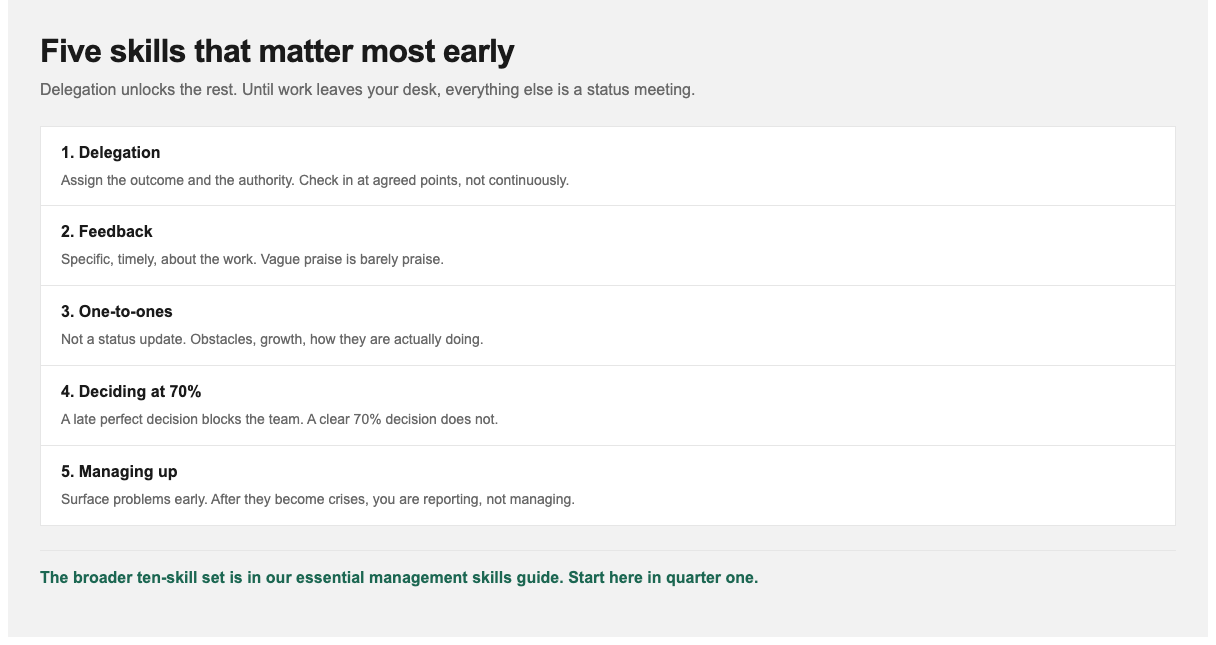
Delegation is the unlock. The other four get easier once work is not stuck on your desk.
For a broader view of the full skill set, including the hard, teachable competencies like planning, budgeting, and performance management, see our guide to 10 essential management skills every new manager needs.
Five Mistakes That Are Hard to Undo
- Staying everyone’s friend. You can be liked and respected, but you cannot be a peer any more. Pretending otherwise makes the first difficult conversation far worse.
- Doing the work yourself. Covered above, and worth repeating because it is the default failure mode of technically strong new managers.
- Avoiding the difficult conversation. The team already knows about the problem. Your silence reads as either approval or weakness.
- Reorganizing too early. Change based on one month of observation usually solves a symptom.
- Neglecting your own development. Management is a distinct discipline with a real body of knowledge. Assuming it is just common sense is how people spend five years relearning things that were written down.
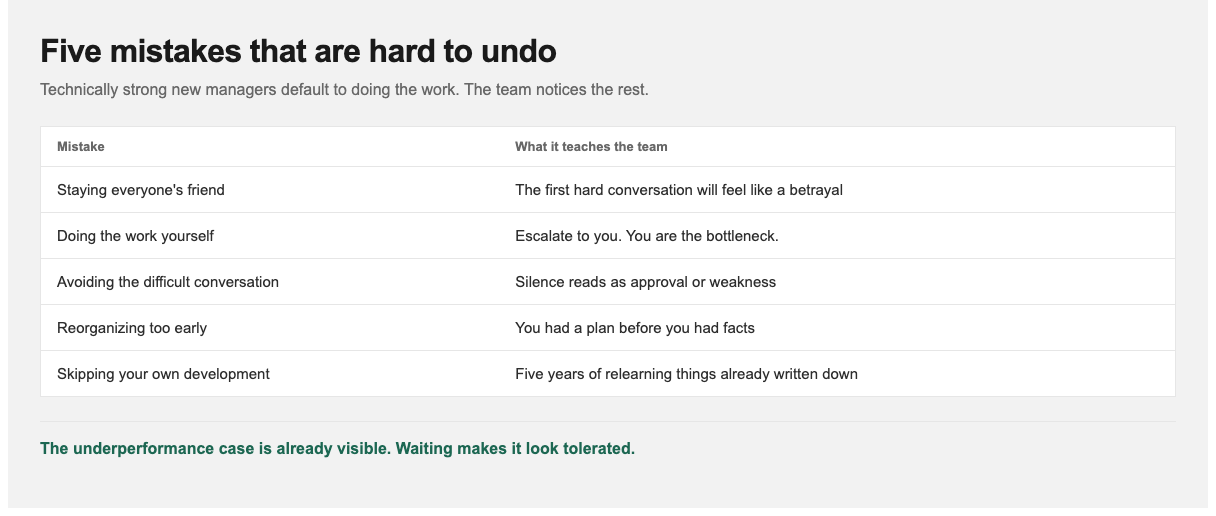
The team already sees the underperformance case. Waiting makes it look tolerated.
How Motivation Actually Works
New managers often reach for incentives when engagement drops. The research is less convenient than that: pay and conditions stop people being dissatisfied, but they do not create motivation. Achievement, recognition, autonomy, and growth do.
Practically, that means the lever you have is usually not a bonus. It is giving someone ownership of something that matters, then recognizing it specifically when they deliver. Our guide to theories of motivation with workplace examples covers the frameworks (Herzberg, Vroom, and others) in practical terms.
When you need a team to reach a decision together rather than defer to you, the nominal group technique is a structured method that stops the loudest voice determining the outcome. If you are managing project delivery as well as people, predictive project management is worth understanding alongside iterative approaches. For how to choose between those, see Agile vs Waterfall.
Management Skills You Can Learn on Purpose
Most new managers get promoted and handed a budget, not a curriculum. The skills above are teachable, and learning them from someone who has managed teams is considerably faster than learning them from your own mistakes in front of your team.
StormWind’s Essential Management Skills is a Business Skills video lesson in the Management Basics series. It covers the mix of skills effective managers need: communication, motivation, process literacy, and how work actually gets done. For managers who need a structured group-decision tool, Decision Making in Groups: Using the Nominal Group Technique is part of a nine-lesson series on high-impact decisions.
Next Steps
Pick one thing from the current phase of your 90 days and do it this week. Most likely a proper one-to-one or a piece of feedback you have been sitting on.
Browse StormWind’s leadership and management courses to build the rest deliberately rather than by trial and error. For more information, visit stormwindstudios.com or reach out to [email protected].
Frequently Asked Questions
What skills do new managers need most?
Delegation, giving feedback, running effective one-to-ones, deciding with incomplete information, and managing upward. Delegation is the one that unlocks the others.
What should a new manager do in the first 30 days?
Listen. Run one-to-ones with everyone, learn how work actually flows, identify informal leaders, and clarify what your own manager expects at 90 days. Avoid reorganizing.
How do I manage people who used to be my peers?
Address it directly and early. Acknowledge the change, be clear about how you will make decisions, and apply the same standards to everyone. Perceived favoritism toward former peers damages the team fastest.
Should a new manager still do hands-on work?
Some, to stay credible. If it fills most of your week, you are working as a senior individual contributor with a manager’s title, and your team is under-led.
How do I give feedback without damaging the relationship?
Make it specific and behavioral, deliver it close to the event, and make it about the work rather than the person. Infrequent, vague feedback does more relationship damage than regular, specific feedback.
When should I address underperformance?
As soon as there is a pattern rather than an incident. Early, private, and specific. The team already sees the problem, and waiting makes it look tolerated.